

OBJECTIVES
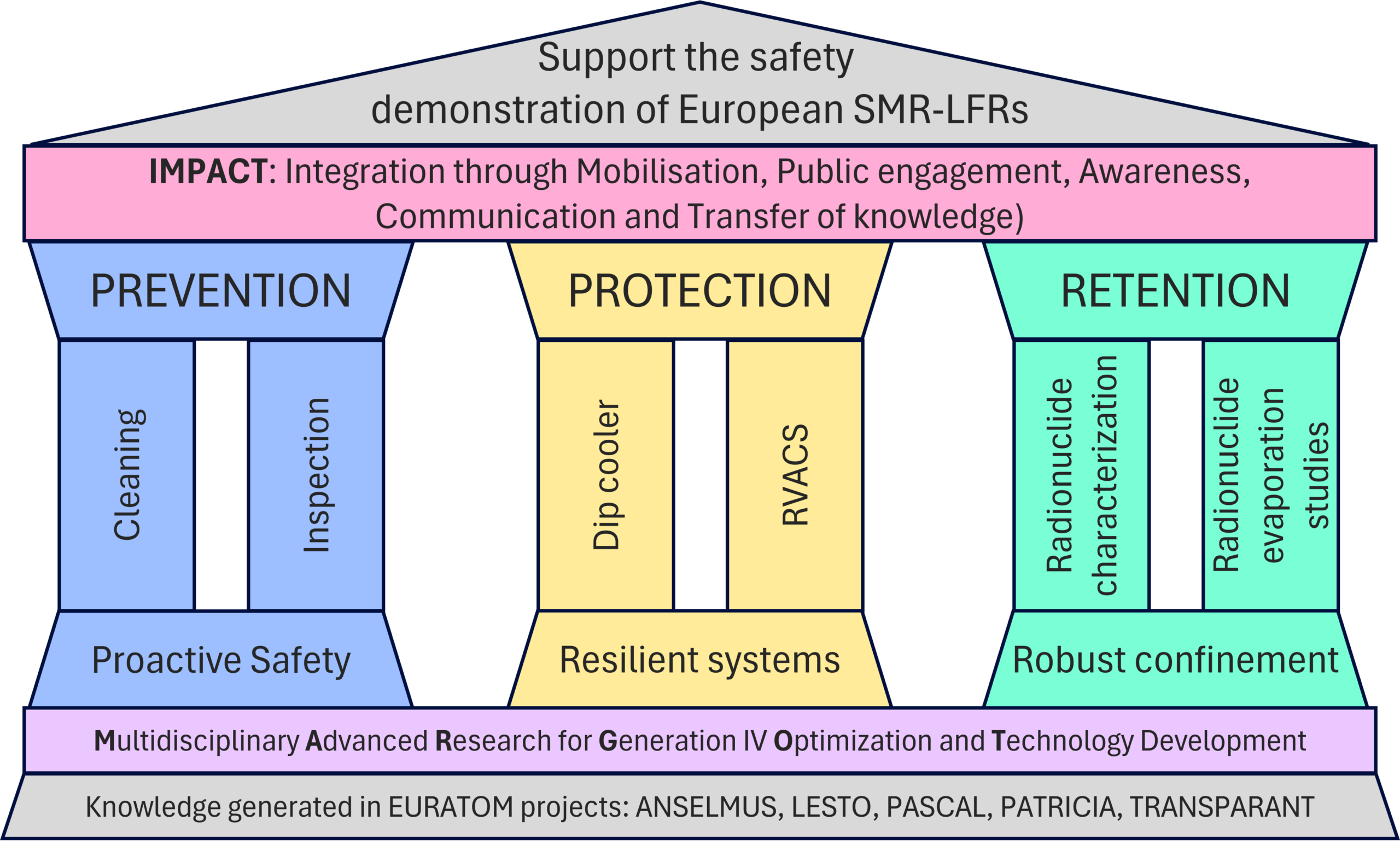 Support the safety demonstration of European Small Modular Lead-cooled Fast Reactors (SMR-LFRs) through three complementary safety pillars:
- Prevention of degradation mechanisms
- Innovative cleaning technologies
- Advanced inspection and qualification
- Protection against abnormal operating conditions
- Passive Dip Cooler systems
- Reactor Vessel Auxiliary Cooling Systems (RVACS)
- Retention of radionuclides
- Characterization of key radionuclides
- Evaporation and transport studies

EXPECTED IMPACT
MARGOT brings together all major European LFR developers, including the ALFRED, LFR-AS, SEALER and LEANDREA programmes, within a single Innovation Action. By tackling common safety challenges and sharing experimental evidence, the project advances a common approach to the safety demonstration of SMR-LFRs.
The resulting technologies, methodologies and datasets will support current pre-licensing activities and future licensing processes, helping to establish a common European safety framework advanced LFRs.
Through the MARGOT Users Group (MUG), the project fosters interaction between reactor developers, research organisations, regulators and end users, maximising the long-term impact and sustainability of its outcomes.

HIGHLIGHTS
Delivering the technologies, evidence and expertise needed for European SMR-LFR deployment along 4 domains.
Proactive Safety
Preventing degradation and ensuring component integrity.
- Advanced inspection technologies (HUSTLE)
- Non-wet lead removal (supercritical CO₂)
- Thermal decontamination, dry (vacuum / hot argon)
Resilient Systems
Demonstrating passive solutions for decay heat removal.
- Prototypical dip cooler qualification (PRECURSOR)
- Spray cooling technologies for wall cooling (HERMES)
- Air-based RVACS activation and performance (SEALER-E)
Robust confinement
Understanding and limiting radionuclide releases from LFRs
- Preparing samples with representative radionuclide mixtures (PSI Transpiration)
- Evaporation and transport in dry and wet atmospheres (PSI Transpiration, POLARIS)
Impact
- Dissemination & exploitation: publications and uptake
- Communication: stakeholder engagement and outreach
- Education & training: HLM School and mobility grants
- Data management: open science, repository (Zenodo)

PARTNERS
SCK CEN / ANSALDO NUCLEARE / VKI / NEWCLEO / BLYKALLA / CHALMERS TH / CRS4 / ENEA / NRG PALLAS / PSI / RATEN / UNI PISA / UNIROMA1 / SIEMENS SAS / SIEMENS SRL / JRC

DURATION
September 2027 – October 2031 (50 months)
4.017.003€, of which €2.999.877 (74.68%) from EU

CONTACT
Project coordinator:
Dr. Julio Pacio (julio.pacio@sckcen.be)

EVENTS
2027: Grant agreement & Kick-off meeting
2028: MARGOT Users Group (MUG) Launch
2029: Heavy Liquid Metal School (June)
2030: Special session at an international conference
2031: Stakeholder workshop