
AMORAC Project
What is AMORAC?
Radiation measurements are manual, repetitive, in potentially very large quantities, and can expose personnel to radiation, showing a lot of potential for automation to decrease the health risks of the personnel, and allowing the personnel to focus on more value-added tasks.
The premises however can be very variable, with slope, stairs, uneven floor, and so on, making it hard to use fixed robots or robots on wheels.
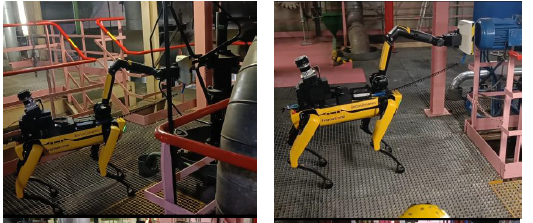
Answering to these needs, Framatome developped AMORAC (Autonomous Mobile Robot for Automated Clearance), a very agile and mobile four-legged robotic solution with a robotic arm able to automate the characterization tasks and documentation in a customizable way. We are developping solution to improve safety, efficiency, adaptability, agility, with state-of-the-art technologies, opening the way to a new standard in the industry for radiation protection.
AMORAC has been developped in labs on a limited scale, but there are many challenges coming with real, large-scale condition, Our objective with the present project was to perform some tests at Blayais nuclear power plant to show the advantage, capacities, and limitations of our robot, in the span of 5 days : inspection of transport containers, road inspection outside, internalinspeciton and navigation of a reato building, etc…
Objectives
The main objective is to get feedbacks from operation in a real environement, check the acceptance of local operators, experience obstacle crossing abilities, benchmark navigation performances and qualify the quality of various measurments.
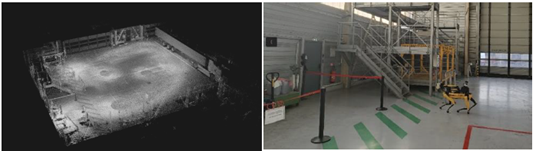
Experiment how the robot fares in its autonomous measuring tasks, whether it has any difficulty when measuring (speed, type of surface, specific obstacles, …), or when moving around in real conditions at the NPP (accuracy of localization, handling obstacles, capacity to keep doing its tasks if an obstacle/problem comes up, taking into account real-life problems that come with complex environments, recording large open spaces, …), tackling some of the obstacles.
Thirdly, it will be an exchange with the NPP operators, to evaluate the limits of what the robotic solution can bring, to listen to any further need that is not yet covered by AMORAC, and to establish how daunting the installation, maintenance, and use of our solution can be, as they will be supervising the test.
Main outcomes
The robot has been extensively tested in obstructed and compact environment with multi-stories environment. It showed a robust ability to avoid any obstacle although the navigation algorithm faced two situations where the mission was abandoned midway. In this case the measurement scenario has been restarted from the latest measurement.
The test campaign took place during a stormy week with wind bursts up to 80km/h and high levels of rain. Some of the experimental equipment on the payload being not IP rated we had to reschedule the road control test as well as change the location of the container storage area (AOC).
Since it was a very first time such a robot is deployed in an NPP, the local safety team was very surprised by the level of autonomy of the system and decided to classify the robot as “drone”. Provided the very short notice, we obtained a temporary exemption for the trials. Nevertheless, further-on, our robot (or similar solutions) will have to undergo some cyber-security assessment before deployment.
Also, we will have to consider applying CEM study on the system, beyond typical characterisations from the CE standards.
Publications
Interest for use of reached results
EDF, RWE, CEA, GIPSALab/IRIT.