
TIFFANY Project
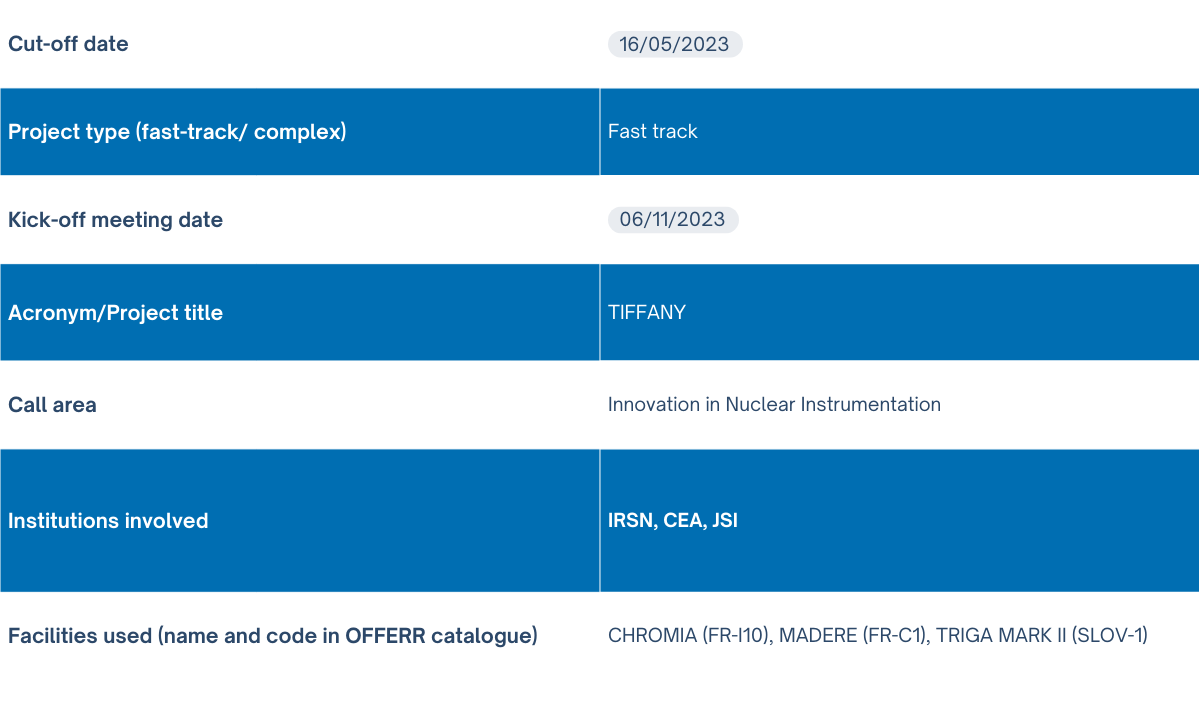
What is TIFFANY?
Reactor dosimetry plays an indispensable role in the management of NPP operating life, development of SMR and fusion, in that it allows for direct experimental data to support decision processes, to validate widely used computational methods and finally to reduce uncertainties on nuclear data. One main issue is the determination of the neutron spectrum covering the thermal energy region up to the fast neutron domain. Presently, combination of activation measurements, radiative capture reactions (n, g) and threshold reactions as (n, p) or (n, alpha) allows to cover respectively the thermal up to resonance energy region (< 1 keV) and the fast neutron energy region (> 1 MeV) of the neutron spectrum. Nevertheless, for neutron in the intermediate energy range (1 keV-1 MeV), there are no referenced reaction that are selectively sensitive. Currently, the epithermal neutron spectrum component is determined mainly on the basis of computational methods. Increasing interest has been raised for a better knowledge of the neutron spectrum in this energy range. It has been recently showed that, for the NPP presently operated, thermal and epithermal neutron fluences have a significant contribution to RPV material ageing. Moreover, the implementation of heavy reflectors in advanced GENIII reactors concept will induce an important increase of the epithermal part of the neutron spectra. The lack of direct determination of the neutron spectrum in this energy region prevents the achievement of sufficiently accurate prediction of the neutron fluence and thus the neutron damage to the reactor structural material – which is a crucial issue in the view of extension of plant lifetime.
The potential of inelastic (n, n’) reactions for fill in the gap in the epithermal neutron region has been recently investigated by computational simulations. Cross sections for inelastic scattering reactions generally are low compared to non- threshold reactions and produces isomers emitting low energy gamma-ray or X-rays which is an issue for accurate measurements. Nevertheless, recent work performed at LDCI (CEA) shows that some material (Sn, Te) can be possible candidate for such determination. In this view, the TIFANY project will aim at investigating the measurements feasibility of isomers produced by (n, n’) reaction of Te in a neutron flux in order to unravel the neutron spectrum in the 1 keV- 1 MeV not covered by classical dosimetry methods.
Objectives
The main objective of the TIFANY project is to contribute to a better determination of the neutron spectrum in the epithermal region by developing a new dosimeter based on 125Te for neutron measurements based on inelastic scattering reaction. The potentiality of 125Te enriched dosimeter to fulfill the requirements for reactor dosimetry in the epithermal region will be investigated. 125Te is indeed a promising candidate allowing to detect neutron above 144.78 keV energy level. The half-life of its isomer is long enough (57.4 days) to allow an accurate measurement even for low energy gamma-ray (35.5 keV) and X-ray (27 keV).
The main challenges of this project will be i/material shaping to match both constraints of reactor irradiation and post irradiation measurements ii/ control of uncertainty along the whole process.
To address these challenges, the TIFANY project will combine experimental and modelling studies and involve three complementary partners facilities of the OFFERR consortium: CHROMIA at IRSN- Cadarache (for dosimeter shaping), and TRIGA MARKII reactor operated by JSI at Ljubljana (for neutron irradiation) and MADERE at CEA – Cadarache (for g– and X-ray spectrometry).
Main outcomes
We have developed a tellurium dosimeter in the form of a pellet 176 microns thick and 7 mm in diameter. The manufacturing process developed has resulted in a pellet that is sufficiently robust to be used during handling during irradiation and measurements.
However, the tellurium dosimeters manufactured in this way remain grainy, which complicates the estimation of the self-attenuation correction factor during gamma spectrometry measurements.
Publications
- TIFANY Project – Tellurium for epithermal neutron dosimetry.
- Preparation and irradiation of new dosimeters made from enriched
- 125T e powder, International Symposium on Reactor Dosimetry (ISRD), May 18-23, 2025, Charleston, USA