
ROXS Project
What is ROXS?
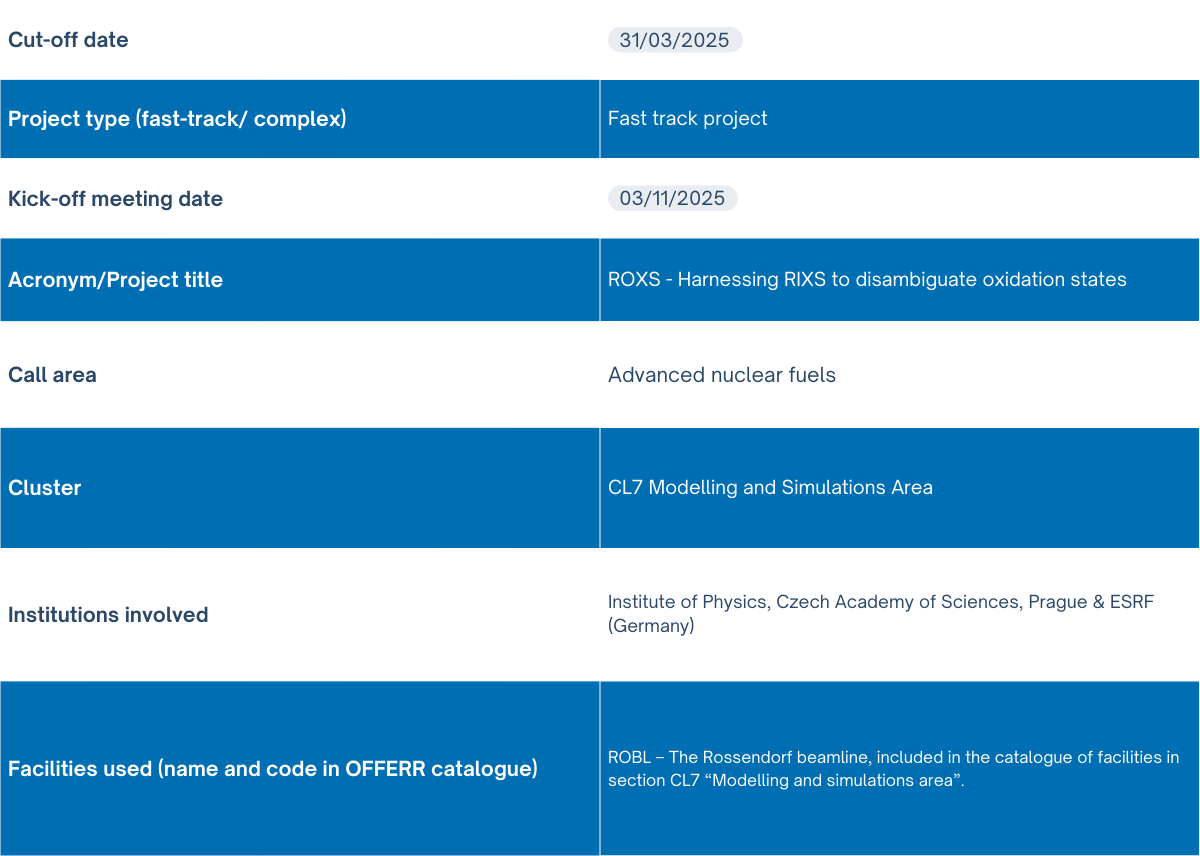
To understand and design better nuclear fuels, it is fundamental to be able to distinguish and quantify the different oxidation states of uranium and other actinides. Currently, the highest sensitivity to actinide oxidation states is given by the high-energy-resolution fluorescence-detected (HERFD) x-ray absorption near-edge structure (XANES) at the M4,5 edges. However, some oxidation states, like uranium in the pentavalent state U(V), remain elusive and the uncertainty of their presence hampers a deeper understanding of the underlying solid-state chemistry. Preliminary theoretical calculations suggest that valence-to-core resonant inelastic x-ray scattering (RIXS) at the uranium L3 edge has a higher sensitivity to the presence of U(V). The aim of this project is to develop the L3 edge valence-to-core RIXS as a new tool to refine the quantification of elusive oxidation states like the pentavalent uranium.
Objectives
The objective of the project is to collect valence-to-core RIXS at the uranium L3 edge on uranium oxide compounds at the ROBL beamline, to perform theoretical calculations in the framework of crystal-field multiplet models with some of their parameters extracted from first-principles electronic-structure calculations, and to determine whether this technique is a viable route to unambiguously disentangle uranium oxidation states.
Main outcomes
After their successful analysis, the experimental data collected on the reference samples will be made publicly available adhering to the FAIR principles. Similarly, it will also be made available the multiplet models and their parameters in the form of ready- to-run input files for the Quanty software (the input files are scripts in Lua programming language).
The experimental and theoretical results, and the description of the new method for disentangling the uranium oxidation states will be published in an international peer-reviewed journal(sand the results will be part of presentation(s) at conferences. Given the short span of the project, presentations of the results in the form of a journal paper and the conference talks are likely to happen only after the project itself is concluded. The experimental method will be made available for users at the ROBL beamline.