

ReSCrZr Project
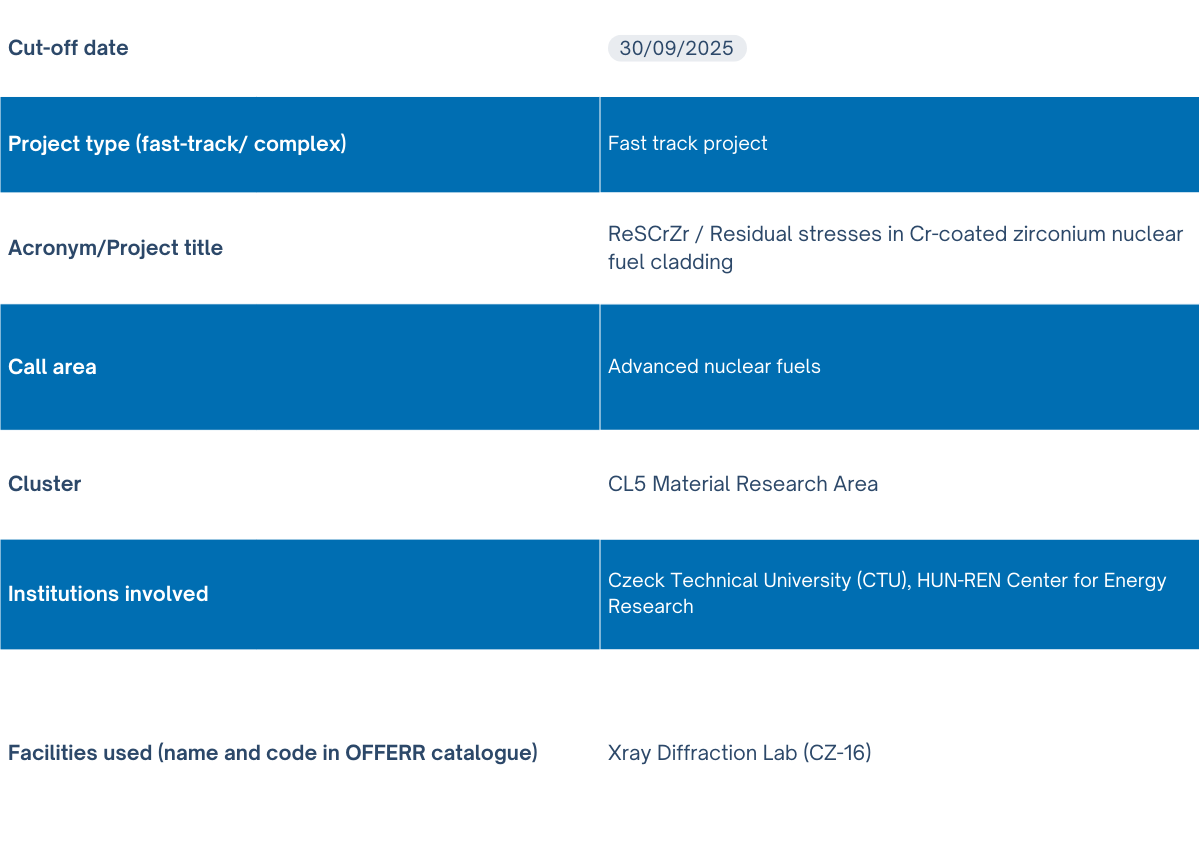
What is ReSCrZr?
Zirconium-alloy cladding with a PVD Cr-coating is the most technologically mature Enhanced Accident Tolerant Fuel (E-ATF) solution currently under development. Coated cladding is considered a “near-term” E-ATF solution, as the concept is based on the application of a thin coating to Zr-alloy cladding tubes where the manufacturing process and properties are well known.
The coating’s properties can be strongly influenced by the residual stresses resulting from deposition. These stresses are dependent on the method/conditions used to deposit the coating and the differences in the properties of the coating and substrate materials. A detailed characterization of residual stresses as a function of coating conditions will improve the comprehension of the coating’s response under the thermal and mechanical stresses imposed during irradiation.
The determination of residual stresses in Cr coatings is complex due to their relatively low thickness (10s of microns) and the strong influence of the coating process conditions on the stress state. The objective of this study is to analyse the residual stresses in various Cr-coated zirconium alloy cladding tubes at temperatures particularly relevant to the nuclear industry (e.g. 20–360°C for nominal operation and 500–900°C for accidental condition). Cladding samples coated under various PVD conditions will be manufactured using two PVD methods and then analysed by the Czech Technical University in Prague. This study will produce data on a fundamental and currently poorly understood characteristic of the Cr coatings deposited using different methods and deposition parameters tested in wide temperature range.
Objectives
The determination of residual stresses in HIPIMS PVD Cr ATF coatings is complex due to their relatively high thickness (10s of microns), strong texture and the strong influence of the coating process conditions on the stress state. The objective of this study is to analyze the residual stresses in various types of HIPIMS and UMS PVD Cr-coated zirconium alloy cladding tubes at temperatures particularly relevant to the nuclear industry (e.g. 20–360°C for nominal operation and 500–900°C for accidental conditions). Cladding samples coated under various PVD conditions will be manufactured by the Czech Technical University in Prague (CTU) using two PVD methods – unbalanced magnetron sputtering (UMS) and high-power impulse magnetron sputtering (HIPIMS). In addition, FeCrAl B136Y alloy as an revolutionary ATF solution will be tested as well in temperature range corresponding to accidental conditions to provide baseline for comparison of Cr coated Zr and advanced steels. This study will produce data on a fundamental and currently poorly understood characteristic of the Cr coatings deposited using different methods and deposition parameters tested in wide temperature range.