
NEXT Project
What is NEXT?
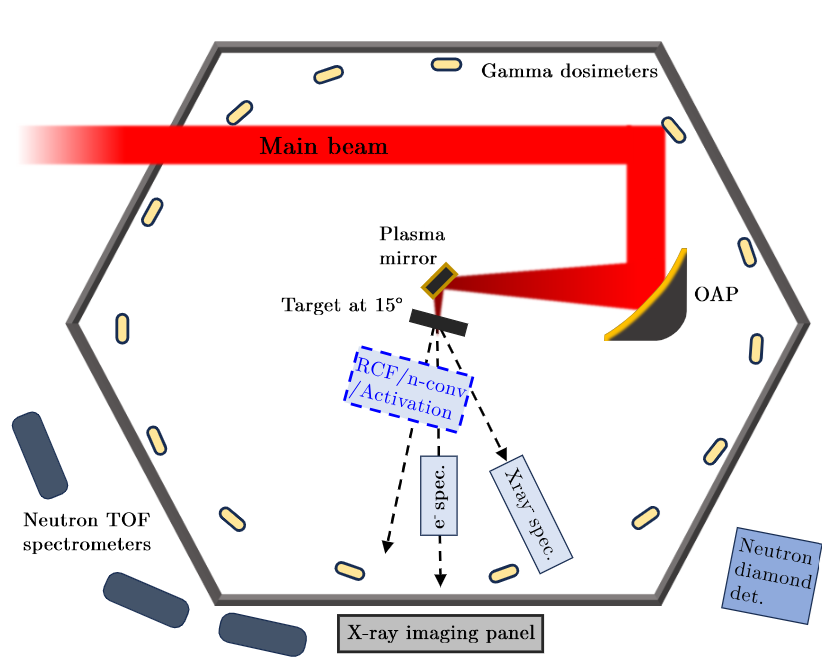
We performed an experiment at ELI-NP to investigate laser-driven high-brilliance sources that offer new perspectives in terms of compact material probing, imaging of high speed events. They moreover offer the possibility of performing multiplexed probing since many (electron, ion, neutron, x-ray) sources can be produced simultaneously in a single shot. We have previously characterized extensively the proton and neutron sources produced by a high-power laser. In this experiment we concentrated on the x-ray source, in view of dual (neutron and x-ray) probing a dense materials. In particular, we made the first quantitative measurements of X-ray spectra and angular distribution in the novel ultra-relativistic regime of very short pulse durations (20 fs) and ultra-high intensity (1022 W/cm2)
Objectives
Our primary goal here is focused on deciphering & characterizing the bright ~Mev-range X-rays that can be produced by multi-PW pulses irradiating thin solids. Note that here, instead of gamma-ray generation in the quantum electrodynamics (QED)- dominated regime (where the solid target needs to stay intact to reflect the ultra-intense laser), we will focus on the regime where the X-rays are efficiently produced by the laser driven electrons under ultra-relativistic intensities, using a partially transparent thin solid target, which corresponds as well to an efficient source of high-energy protons.
At sub-PW levels, there have been various x-ray generation mechanisms proposed theoretically and experimentally measured. However, when it comes to the novel regime of ultrarelativistic laser-matter interactions, direct measurements and characterizations of pulsed, hard X-ray generation above hundred-keV level have been missing. During our commissioning of Apollon at the sub-PW and multi-PW levels, we have built a robust platform for the generation and characterization of a laser driven proton/neutron source. We have been able, at the multi-PW level, to generate proton beams with maximum energy ~56 MeV from 6-µm-thick Al foils and to characterize the secondary neutrons. What we have also found is that the ratio of the X-rays and neutron sources can be tuned by playing on the material and thickness of both the primary (pitcher) and secondary (catcher targets). Yet, the dominant mechanism that is responsible for the X-rays generation, under different target thickness and material, is not clear.
Therefore, our emphasis here is on X-ray characterization. Our ambition here is thus to:
1. systematically characterize the X-rays, which we observe are very suitable for high resolution radiography generated in this ultra-relativistic regime with a thin solid target for the first time experimentally.
2. Enable a novel and bright dual (X-rays & neutrons) source, to test whether a compact, laser-based solution for both density probing (X-rays) and element analysis (neutron) would be possible.
Main outcomes
Our characterization of the emitted protons show that the highest proton acceleration can be accelerated in two different scenarios, similar to what we have already observed in our former experiments. On the one hand, when the laser interacts with a thick target that still has a solid surface, i.e., the case with 2 μm Al, we are in the typical TNSA regime and we get the protons with the highest cutoff energy, i.e., 27.6 MeV. On the other hand, when the laser interacts with a thin target that has fully exploded by the pre-pulse into a large-scale but low-density plasmas, i.e., the case with 30 and 150 nm SiN2, we move to the CSA regime and we get the second highest proton cutoff energy, i.e., 23.3 MeV.
For the electrons we found a peak temperature of ~15 MeV for a target of 2μm Au and the data shows that the conversion efficiency increases with the target thickness while the temperature of the electrons peaks at a thickness of 2μm Au and decreases with a further increase of the target thickness.
The obtained X-ray spectra display typical features of bremsstrahlung radiation, following a power-law distribution of power -1 with an exponential-like cut-off, as described by Kramer’s law, around 100 MeV. While the maximum photon energy remains comparable across the different target materials; with the highest values reached around 2-3 μm gold, consistent with the electron data; the photon yield shows significant variations. As expected from the Z2 scaling of bremsstrahlung emission, the high-Z gold target (Z = 79) generates a substantially larger number of photons than aluminium or silicon nitride. This enhanced photon production is also evident in the laser-to-photon conversion efficiency measured by the detector. Gold displays a noticeably higher conversion ratio than aluminium, particularly at larger target thicknesses.
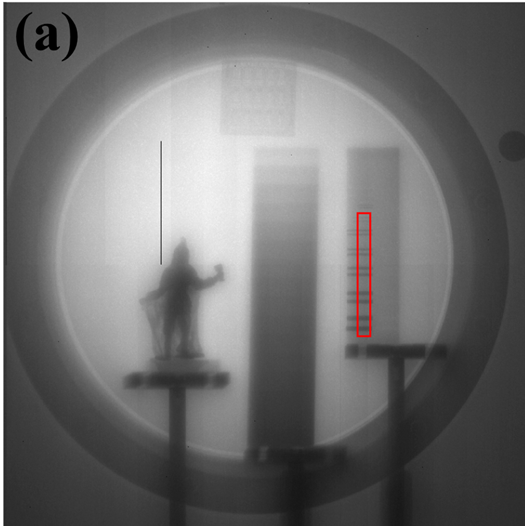
To measure other X-ray characteristics, the X-ray burst was used to image multiple radiography objects, including a line pair gauge Image Quality Indicator (IQI), using a Perking Elmer 1621 X-ray panel amorphous silicon panel. The effective radiograph source sizes of the detected x-ray emission for different targets were calculated by taking the FWHM of the PSF for each shot. The source sizes area measured is 3 to 2 mm with
thicker foils producing smaller sources and better images.
Publications
Assessing the generation of laser-induced simultaneous and brilliant X-ray and neutron beams, in view of a dual radiography capability, expected to be submitted in jan 2025
Interest for use of reached results
LULI – CNRS, CEA, UPMC Univ Paris 06 : Sorbonne Université,
Ecole Polytechnique, Institut Polytechnique de Paris – F-91128 Palaiseau cedex, France
Department of Physics, Technion, 32000 Haifa, Israel.