

NESTRAFE Project
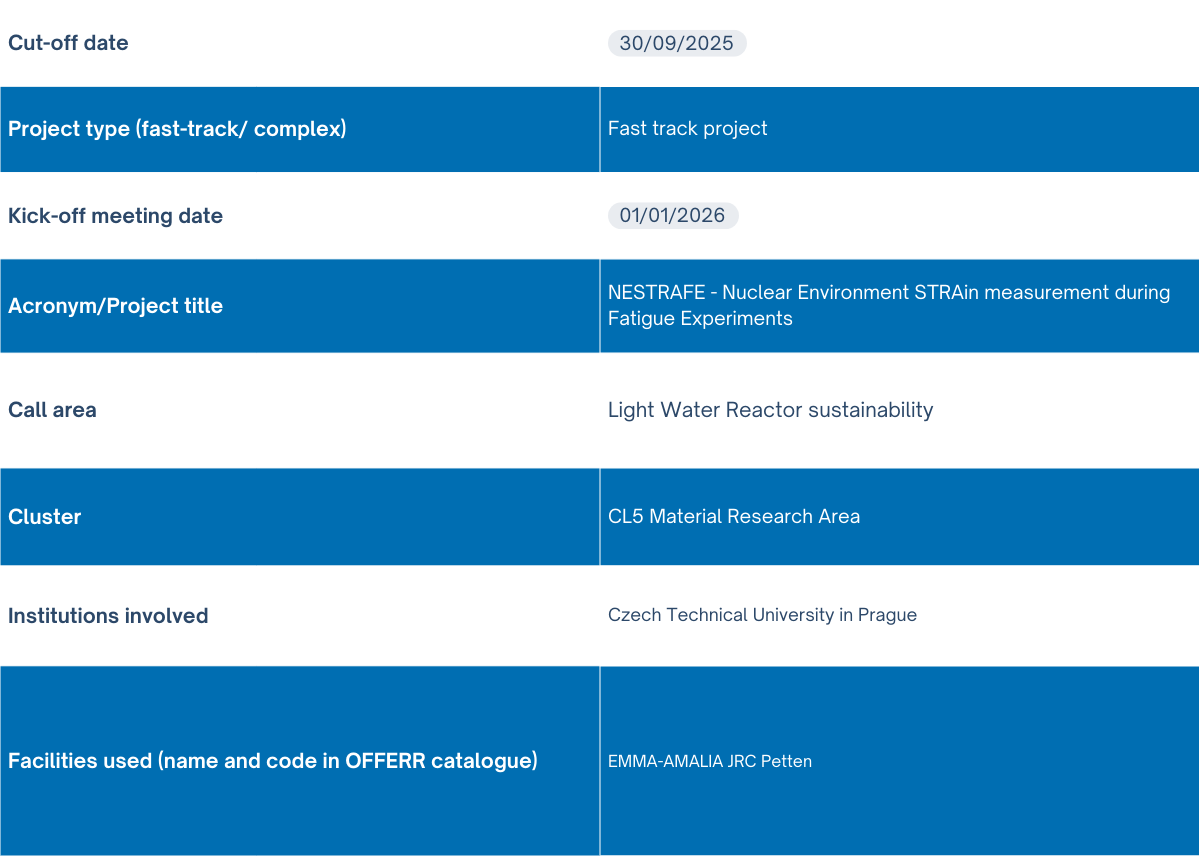
What is NESTRAFE?
Environmentally Assisted Fatigue (EAF) is a key degradation mechanism limiting the lifetime of structural components in nuclear power plants. Materials in the primary circuits of PWR and VVER reactors operate under high temperature, high pressure, and corrosive water conditions. Despite decades of international research, including initiatives such as the INCEFA projects, fatigue life predictions remain highly uncertain, with major knowledge gaps still present.
Direct, high-fidelity strain measurement during fatigue testing is crucial to reduce these uncertainties. Strain-controlled experiments provide precise control of specimen deformation, enabling accurate characterization of stress-strain response, cyclic hardening or softening, and the initiation and growth of microstructural damage. However, replicating reactor environments in autoclaves—combining high temperature, high pressure, and corrosive water chemistry—creates significant technical challenges for implementing such measurements.
The NESTRAFE project is designed to bridge this gap by developing reliable methods for direct strain measurement during strain-controlled fatigue experiments in autoclave conditions. By enabling precise, real-time monitoring of strain, NESTRAFE will deliver a more accurate understanding of EAF processes. This capability will also improve constitutive models and fatigue life prediction methods, providing essential input for safety assessment, lifetime extension, and design optimization of nuclear components.
In essence, NESTRAFE addresses a fundamental need in nuclear materials research: direct, accurate strain measurement under realistic environmental and mechanical loading. By reducing uncertainty and advancing mechanistic understanding, the project supports the development of next-generation predictive fatigue models, ultimately enhancing the reliability and safety of nuclear power plant operations.
Objectives
The overall objective of the NESTRAFE project is to develop and demonstrate a reliable method for direct strain measurement during fatigue experiments in autoclave environments representative of PWR and VVER primary water conditions that can be used in similar types of autoclaves in various laboratories. By addressing current limitations of indirect strain monitoring, the project aims to generate more accurate fatigue data for structural materials used in nuclear power plants.
The specific objectives are:
- Design and fabrication of a measurement system capable of withstanding high temperature, high pressure, and corrosive autoclave environments.
- Integration of the measurement system within an existing fatigue testing facility.
- Comparison of direct and indirect strain measurements to quantify uncertainties associated with conventional displacement-based methods.
- Application to representative materials, such as austenitic stainless steels (e.g. AISI 316L), to provide high-quality Environmentally Assisted Fatigue (EAF) data.
By achieving these objectives, NESTRAFE will enable more accurate strain-controlled testing, reducing the reliance on repeated calibration, FEM model, and elastoplastic characterization for each new specimen type. The improved reliability of fatigue life assessment will contribute directly to more realistic component lifetime predictions, supporting long-term operation, safety, and efficiency of existing nuclear power plants.
Main outcomes
The NESTRAFE project will deliver a methodology for direct strain measurement during fatigue testing in autoclave environments, addressing a key gap in nuclear materials research. The scientific outcome will be a comprehensive dataset comparing direct and indirect strain measurement techniques on representative LWR materials (e.g., AISI 316L). This will enable improved mechanistic understanding of environmentally assisted fatigue and provide high-quality input for predictive lifetime models, supporting safe long-term operation of nuclear power plants.
In addition, the project will generate design and technical documentation for experimental fixtures and sensor integration. The methodology and results will directly benefit the nuclear materials research community and operators seeking to extend plant lifetimes.
Dissemination will include:
- Peer-reviewed publication in international journal on nuclear materials and structural integrity.
- Open-access datasets where feasible, to foster transparency and collaboration.
Through these activities, NESTRAFE will ensure broad visibility and uptake of its findings, promoting their use in both academic research and nuclear industry practice.
The NESTRAFE project proposes to deliver:
- Technical drawings and design documentation of the new direct strain measurement system.
- Manufactured and assembled prototype of the measurement device suitable for autoclave fatigue testing.
- Installation and functional testing within an autoclave facility (EMMA-AMALIA).
- Experimental dataset comparing direct vs. indirect strain measurements under fatigue loading.
- Final project report including methodology, results, and recommendations for future applications.