
NANOPROBE Project
What is NANOPROBE?
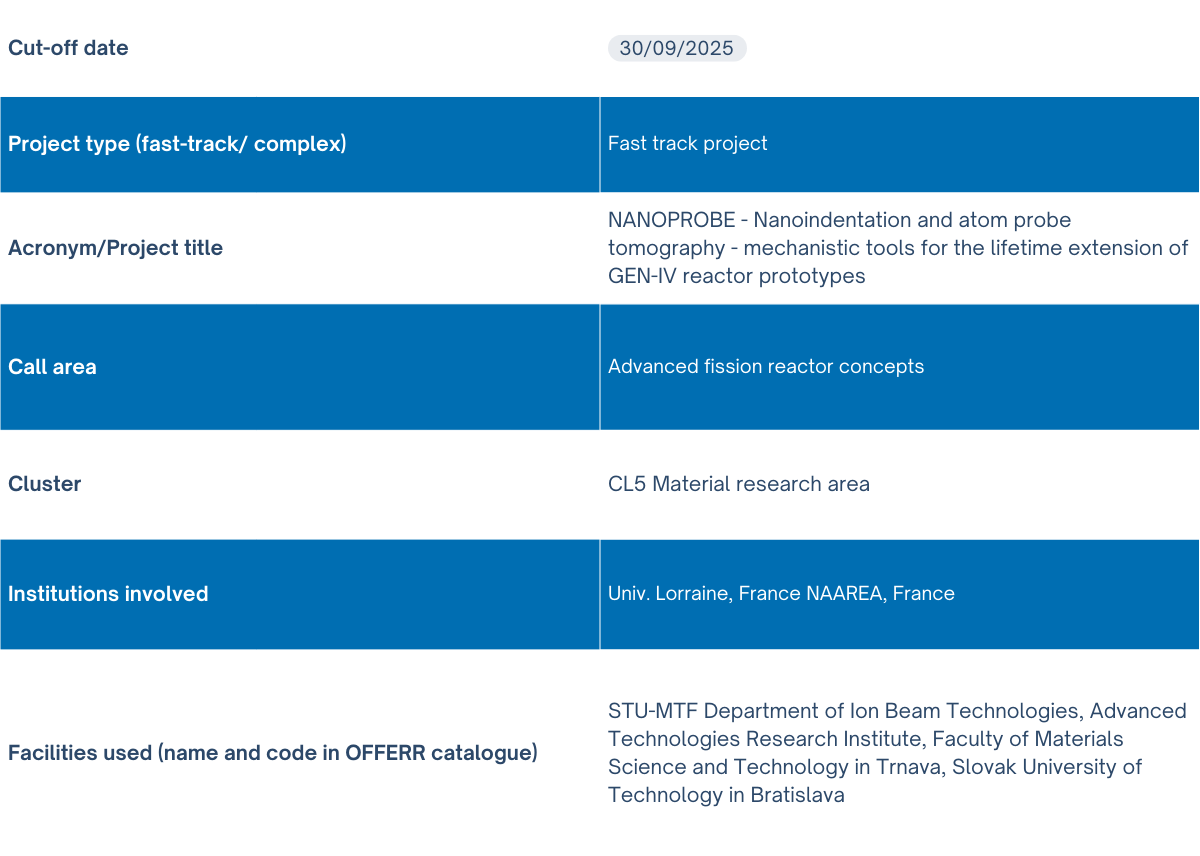
The NANOPROBE project addresses one of the central challenges in advanced fission reactor development : the qualification of structural materials under extreme irradiation conditions. Inconel 625, a nickel-based alloy with high creep strength and corrosion resistance, is considered a promising candidate for molten salt fast reactor (MSFR) prototypes. However, the lack of systematic irradiation data across the reactor-relevant temperature range (650 – 750 °C) limits its qualification pathway.
To overcome the scarcity and cost of neutron irradiation campaigns, this project will employ high-temperature ion irradiation as a surrogate to simulate displacement damage and helium production in Inconel 625. The irradiated samples will then be characterized using two complementary techniques : atom probe tomography (APT), which enables atomic-scale analysis of solute segregation, clustering, and precipitation; and nanoindentation, which provides localized measurements of mechanical properties such as hardness and irradiation-induced hardening. Together, these methods establish a direct correlation between nanoscale chemical changes and mechanical degradation.
The generated dataset will form the foundation for constructing property–dose–temperature curves that bridge ion irradiation with neutron irradiation results. These curves will enable the prediction of long-term swelling and embrittlement behavior, supporting model calibration and lifetime assessment of structural components. By combining advanced ion irradiation testing with state-of-the-art characterization, NANOPROBE will deliver essential input for accelerated materials qualification, directly benefiting end-users such as NAAREA in the design and safety evaluation of molten salt reactor prototypes.
Objectives
The project will generate the first ion irradiation data sets on a GEN-IV candidate material, which will later be compared with neutron irradiation results after the project conclusion (neutron irradiation and characterizations are outside of the OFFERR funding request). This will provide a foundation for model calibration and strengthen the predictive link between nanoscale defect evolution and microscopic/macroscopic material performance.
NANOPROBE will pursue the following specific objectives :
- Establish an initial but robust experimental data set on the microstructural and mechanical response of a GEN-IV candidate material (a nickel-based alloy (Alloy 625) will be used in this project) to high-temperature ion irradiation, focusing on segregation, clustering, and precipitation.
- Link some nanoscale features to mechanical degradation by combining atom probe tomography (APT) and nanoindentation, providing a direct correlation between irradiation-induced microstructural changes and irradiation effects such as hardening and embrittlement.
Develop property–dose–temperature relationships that would be compared with NAAREA’S future post-irradiation examination (PIE)of candidate alloys irradiated in its own prototype or in a fast neutron reactor (irradiation and PIE outside of this OFFERR project coverage) – this comparison will enable the calibration of models with neutron irradiation data that could help extend the lifetime of structural components.