

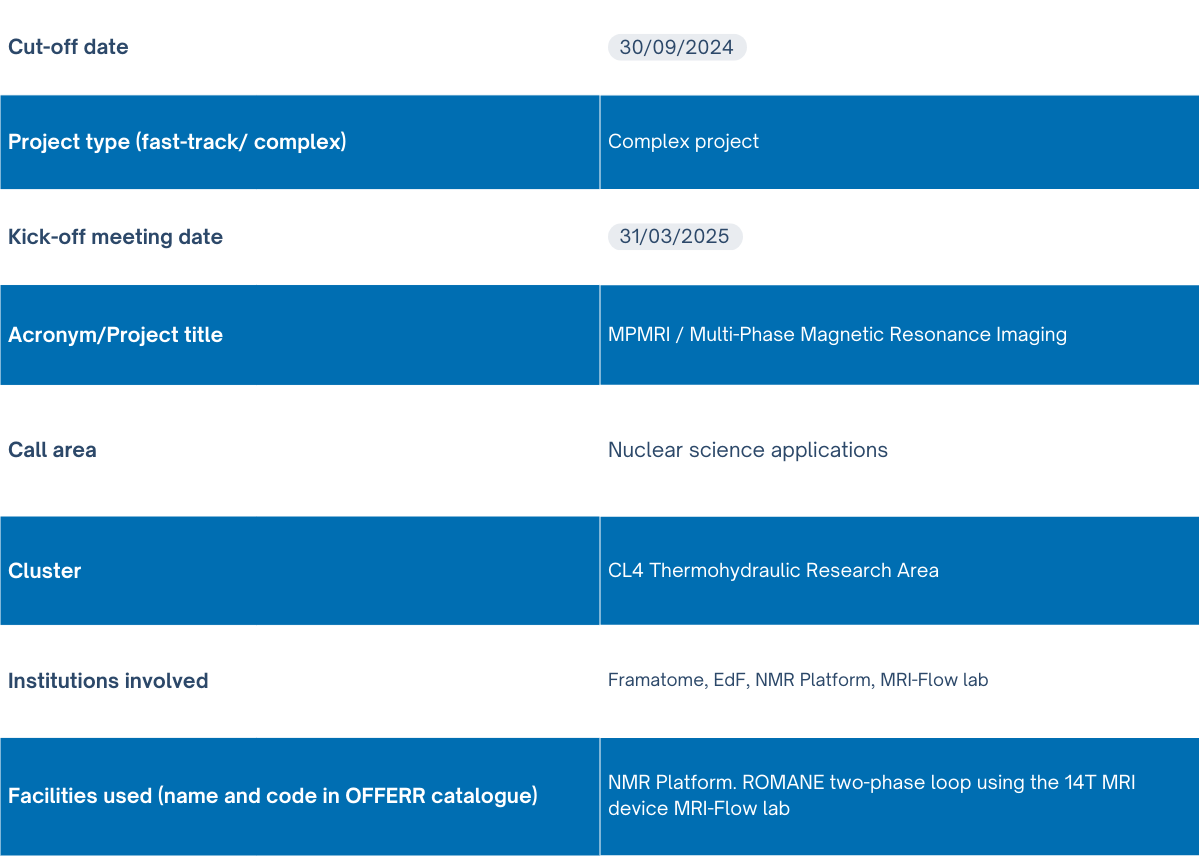
MPMRI Project
What is MPMRI?
Magnetic Resonance Imaging (MRI) offers a non-invasive, high-resolution technique capable of providing detailed, three-dimensional images of flow fields. Applying MRI to multi-phase air-water flow systems represents a novel approach that can bridge existing gaps in experimental data, offering unprecedented insight into the internal flow structures and dynamics. This technique can capture the complex interactions between phases and provide comprehensive data sets necessary for validating and refining CFD models.
This study aims to perform experiments on bubbly flow within fuel assembly mock-ups, generating high-resolution, three-dimensional fluid mechanics data for validating and enhancing multi-phase CFD models. The benchmark employs a non-proprietary geometry and features for a mixing grid. Air is injected into the water flow at specified points upstream and within the mixing grids.
The application of MRI to multi-phase air-water flow analysis presents a groundbreaking opportunity to advance the field of thermal-hydraulics in nuclear engineering. By addressing the limitations of current experimental techniques and providing high-resolution, three-dimensional flow data, this research will contribute significantly to the optimal design and safety of nuclear fuel assemblies and other critical multi-phase flow systems.
Objectives
This study aims to perform experiments on bubbly flow within fuel assembly mock-ups, generating high-resolution, three-dimensional fluid mechanics data for validating and enhancing multi-phase CFD models. The benchmark employs a non-proprietary geometry and features for mixing grids. Air is injected into the water flow at specified points upstream and within the mixing grids.
Within the investigated parameter space, a broad range of flow regimes will be explored, from single large bubbles to dispersed small bubbles, providing a robust experimental dataset for CFD validation. The experimental data achieved within this project include:
- Three-dimensional mean velocity field and mean void fraction in the full flow volume from shortly upstream to about ten hydraulic diameters downstream of the mixing grids
- Bubble size distribution measured at selected locations
- Full description of the boundary conditions including mass flow rates, pressure drop, inlet velocity profile.
- For selected cases: Three-dimensional turbulence measurements
Main outcomes
Deliverables
The primary objective of the MPMRI project is to develop and validate a comprehensive methodology that integrates 3D MRI technology to measure both velocity and void fraction within turbulent flow of fuel assembly mock-ups. Secondly, CFD grade validation data will be provided:
- 3D3C velocity and 3D mean void data at a sufficient resolution to characterize the flow in the subchannels
- Bubble size distribution data (1D MRI and 2D Shadowgraphy) at selected positions
- 3D6C Turbulence / Reynolds Shear Stresses (RSS) data for selected cases
- Facilitate the creation of a robust database that serves as a reference point for future research and development in the field
Scientific outcome + dissemination plans:
The MPMRI project will significantly advance our understanding of two-phase flow in nuclear fuel assemblies. The project aims to refine the current understanding of fluid dynamics in nuclear reactors and to enhance the reliability of existing CFD models, providing a more detailed description of the complex phenomena occurring within nuclear reactors. This project will also help to develop MRI techniques in nuclear safety studies, and more widely in any scientific domain involving two phase flows.
Results will be published in scientific journals of the nuclear and/or the fluid mechanics domains. Significant data will be deposited in open access repository (e.g. rechercher.data.gouv.fr,…) in order to be useful to other researchers.
Publications
Submitted:
- Kristine John, David Frank, Swantje Romig, Henry Brömmelkamp, Vincent Fichet, Audrey Arthaud-Berthet, Elodie Mery de Montigny, Florian Vinauger, Markus Rehm, Sven Grundmann, Martin Bruschewski (2025): “3D Measurement of Mean Velocity, turbulence, void fraction, and temperature in a fuel assembly model with 5 x 5 split-type mixing vane configuration using magnetic resonance imaging”, CFD4NRS-10, Mito City, Japan, Dec. 10-12, 2025.
Planned:
- Martin Bruschewski et. al. (2026): “3D Measurement of Mean Velocity, turbulence, void fraction, and temperature in a fuel assembly model with 5 x 5 split-type mixing vane configuration using magnetic resonance imaging”, Nuclear Engineering Design.
Interest for use of reached results
Framatome SAS, Framatome GmbH, EDF, and all other industries and research institutes, where 3D experimental fluid mechanics data are needed to calibrate and improve CFD simulations of coolant flows.