
MIND-UR Project
What is MIND-UR?
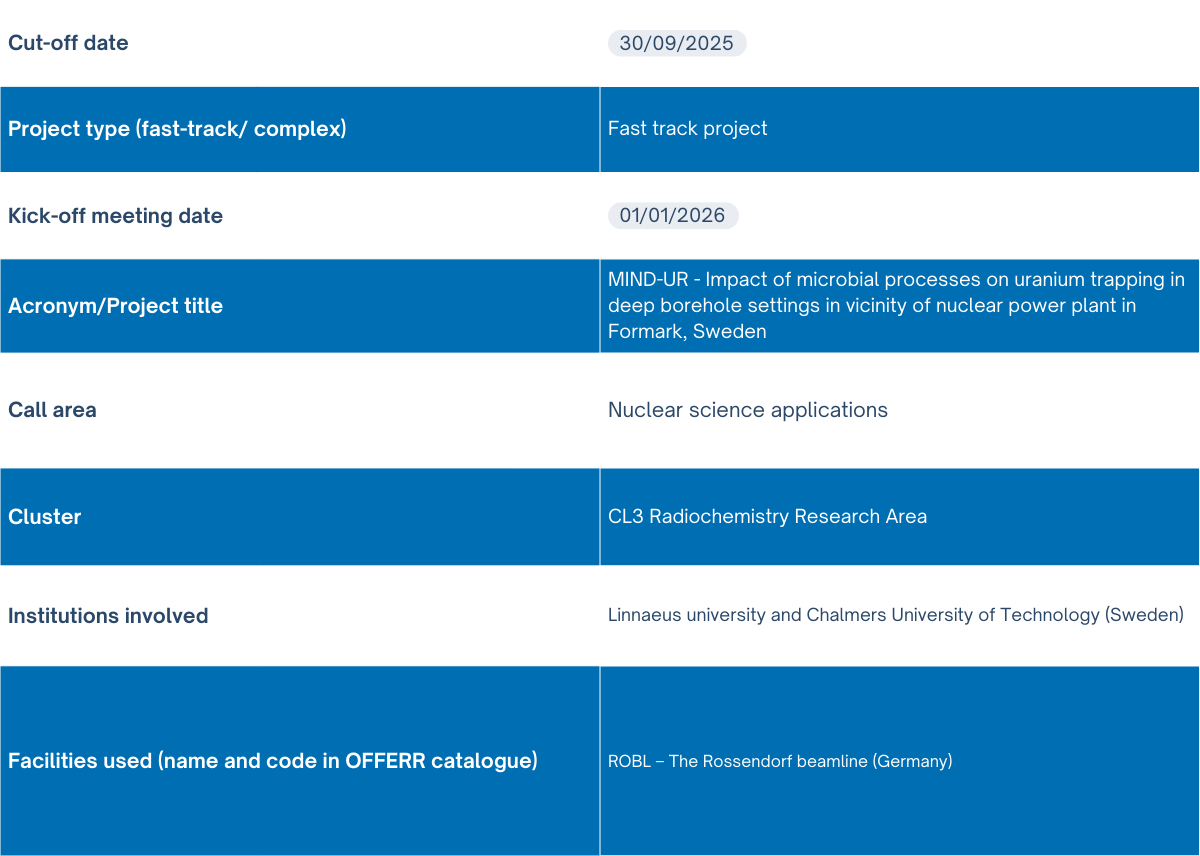
Natural uranium (U) mobility in deep groundwater is a critical concern for the long-term safety of geological repositories for spent nuclear fuel (SNF). During site investigations at Forsmark, Sweden, elevated U concentrations were detected at ~500 m depth—coinciding with the proposed repository horizon—highlighting both a potential risk and a natural analogue for U behavior in crystalline bedrock.
Recent findings in similar geochemical settings have demonstrated unexpectedly high U uptake into secondary minerals under anoxic conditions, facilitated by microbe-mediated redox processes. These results suggest that indigenous microbial communities may play a significant role in immobilizing U and other heavy metals through mineral trapping, offering a potential biogeochemical barrier to radionuclide migration.
This project investigates the microbial mechanisms behind heavy metal immobilization in deep subsurface environments, with direct relevance to SNF repository safety. Incubation experiments using various metal substrates are being conducted, coupled with advanced micro-scale analyses of metal speciation and distribution. This project requires employment of the infrastructure: synchrotron-based techniques, X-ray fluorescence mapping and high-energy resolution X-ray absorption spectroscopy (ROBL -Rossendorf beamline at ESRF), to determine U redox states and localization in microbial incubates and mineral precipitates from deep borehole samples.
By elucidating the pathways of microbially mediated U immobilization, this research contributes to a deeper understanding of natural attenuation processes in repository environments. The outcomes are directly applicable to the OFFERR call, supporting the development of robust safety cases, improving predictive models of radionuclide transport, and informing strategies for environmental monitoring and remediation around SNF facilities.
Objectives
The aim of this project is to gain fundamental insights into how biogeochemical factors affect the retention of heavy metals from deep groundwaters in vicinity of nuclear facilities, particularly aiming at U immobilization from groundwater. More specifically the objectives are: 1) Investigation of U redox states in biotic precipitates forming after microbial incubation of U-rich groundwater from deep anoxic groundwater in Forsmark site; 2) U sequestration and redox analysis in mineral precipitates on borehole equipment collected from deep bedrock sections, corresponding to U-rich groundwater circulation zones after an 18-year in situ experiment. A comprehensive experimental approach will be implemented involving the study of various isotope proxies in mineral precipitates down to 500 m depth below Baltic Sea level, integration with microbiological studies, advanced analytical methods including synchrotron techniques at ROBL and cross-correlation between natural and laboratory settings. The multi-disciplinary approach of using indigenous waters, microbial communities and mineral precipitates allows discrimination between multiple U redox and removal pathways and makes feasible the assessment if the rates of these processes.
Main outcomes
Data on U redox distribution, e.g., proportion of U(V), will be retrieved from advanced synchrotron-based results. Additional information on a nano/micro-scale U distribution, topology and morphology of precipitates will be obtained from advanced microscopy investigations. This data will be linked to U redox signatures from δ238U – an emerging isotopic signature to differentiate between bacterial and abiotic redox proxies and linked to the spectroscopic data. This knowledge will be used specifically for further planning and construction of the SNF and SFR repositories in Forsmark started in 2022. The obtained results will help to propose more novel techniques for micro-scale detection of heavy metal and radiotoxic species and efficient strategies for their removal that can be utilized for environmental remediation at engineered sites where elevated U concentrations persist.
At least one article in a peer-reviewed scientific journal will be the result, along with presentations at (inter)national conferences, workshops, and seminars. Considering the high potential of the preliminary results it is reasonable to aim at top-tier environmental journals, e.g., Environmental Science & Technology, Environmental Chemistry Letters, Journal of Hazardous Materials. Outreach is planned through multiple communication activities, with a high potential for dissemination on (inter)national media, i.e. TV, blogs, and popular scientific magazines.