

DIAMRI Project
What is DIAMRI?
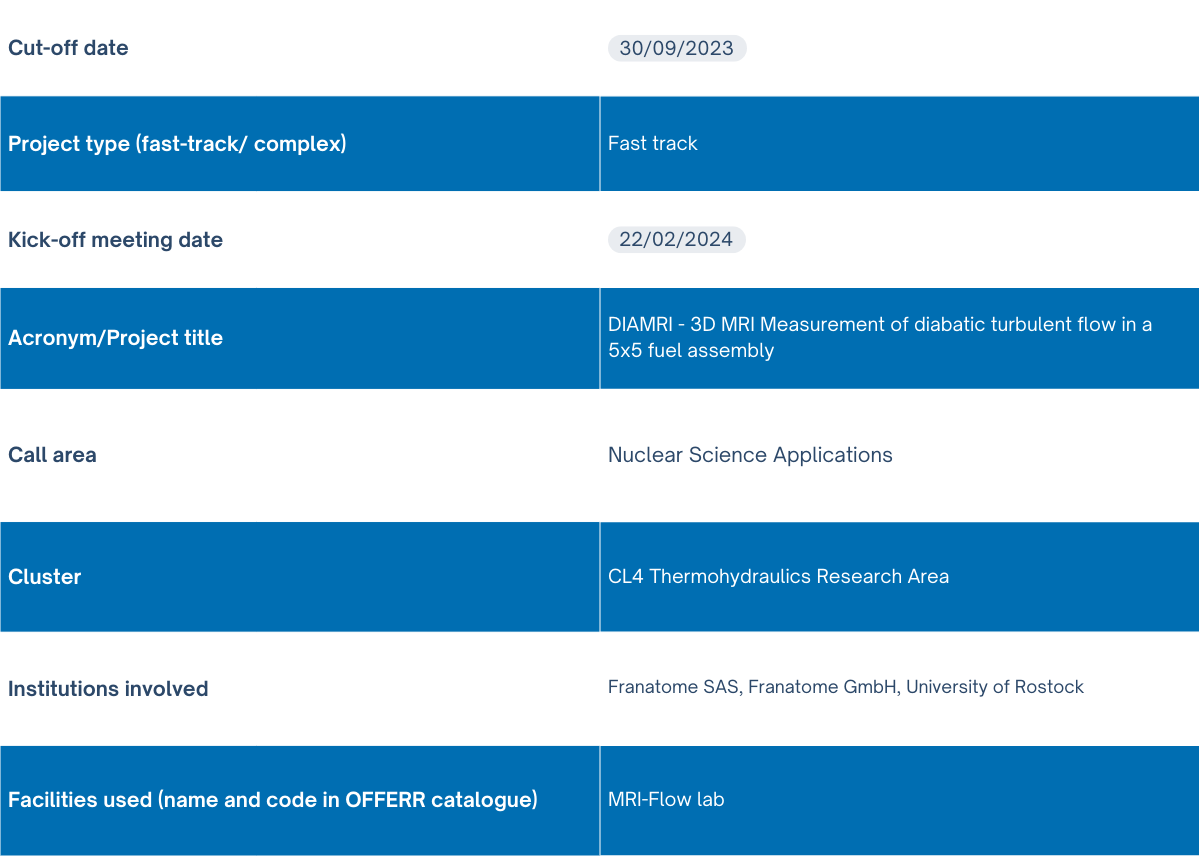
The DIAMRI project aimed to develop and validate an experimental methodology for the simultaneous measurement of velocity and temperature in turbulent water flows without probes or optical access. The approach relies on velocity-sensitive and temperature-sensitive Magnetic Resonance Imaging (MRI), also known as Magnetic Resonance Velocimetry (MRV) and Magnetic Resonance Thermometry (MRT). As a pilot study, DIAMRI represents the first application of these techniques to diabatic turbulent flow under reactor-representative conditions, intending to provide high-resolution three-dimensional data for the validation of Computational Fluid Dynamics (CFD) models.
The project was carried out over five months in two dedicated work packages: the design of an MRI-compatible heating system for a 5×5 fuel assembly mock-up and the development of MRI-based methods for three-dimensional temperature field measurements. The heating system was realized using an internal copper heat exchanger supplied with hot water, overcoming restrictions imposed by MRI on materials and the incompatibility of electrical heating.
The results confirm the feasibility of MRI-based velocity and temperature measurements in complex turbulent flows and establish a foundation for future benchmark studies. DIAMRI thus provides both methodological validation and a pilot database for CFD model development. Future research will extend this approach to more advanced benchmark cases and applied fuel assembly geometries, requiring improved heating systems, higher measurement precision, and extended experimental campaigns.
Objectives
The primary objective of the DIAMRI project was to develop and validate a comprehensive experimental methodology for measuring velocity and temperature in turbulent water flows without the need for probes or optical access. The approach relies on velocity-sensitive and temperature-sensitive Magnetic Resonance Imaging (MRI), commonly referred to as Magnetic Resonance Velocimetry (MRV) and Magnetic Resonance Thermometry (MRT). DIAMRI serves as a pilot study to further advance and validate these techniques under reactor-representative flow conditions.
The benchmark case was designed in alignment with the OECD/NEA–KAERI MATiS-H benchmark, where the central rod was heated to generate a measurable temperature gradient within the flow field. The project spanned five months, organized into two focused work packages, and was conducted entirely at the host facility in close collaboration with the User’s team. As the initial step in a broader research initiative, DIAMRI sought to:
- Expand the characterization of the flow field by complementing 3D velocity data and Reynolds Shear Stresses (RSS) with high-resolution 3D temperature measurements.
- Improve understanding of the coupled dynamics between fluid motion and thermal variations in reactor-relevant conditions.
- Support the development of innovative reactor designs and enhanced safety protocols through refined descriptions of turbulent thermal mixing.
- Establish a robust, high-quality experimental database to serve as a benchmark for future research and model validation.
The resulting data are expected to substantially strengthen the validation of Computational Fluid Dynamics (CFD) models by providing a more comprehensive and reliable experimental foundation.
Main outcomes
The project was structured around two major work packages: (1) the design of a heating system for the central rod in the 5×5 fuel assembly mock-up, and (2) the development of an MRI-based method to measure three-dimensional temperature distributions in the flow field. The heating system represented the most critical design challenge, as the use of MRI imposed strict material restrictions. Conventional electrical heating was not feasible due to electromagnetic interference with the measurement system.
To address these constraints, the central rod was equipped with an internal copper heat exchanger supplied with hot water. A key objective of the design was to generate sufficiently large temperature gradients in the fluid to allow for accurate MRI-based detection. Preliminary CFD simulations provided by the User’s team supported the heating system design, and the initial target Reynolds number was set at 50,000.
After commissioning, the first measurements revealed that the induced temperature differences were too small for reliable detection. The MRI system exhibited a noise level of approximately 0.1 K, while the maximum temperature difference achieved was only about 1 K. To compensate for heating power limitations, the Reynolds number was reduced to 20,000. This adjustment more than doubled the temperature differences and enabled sufficiently precise measurements.
The DIAMRI project thus demonstrated the feasibility of MRI-based velocity and temperature measurements in diabatic turbulent flow, serving both as a pilot study and as validation of the experimental methodology. Future work may extend this approach to more complex benchmark studies and applied fuel assembly mock-ups. Advancing this line of research will require improved MRI-compatible heating systems, higher temperature measurement precision, and longer measurement campaigns, supported by greater resources than were available in this fast-track project.
Results
Publications
Publication for submission in Nuclear Engineering & Design in preparation. Submission by the end of 2025.
Interest for use of reached results
Framatome SAS, Framatome GmbH, EDF, and all other industries and research institutes, where 3D experimental fluid mechanics data are needed to calibrate and improve CFD simulations of coolant flows.