

CORREX Project
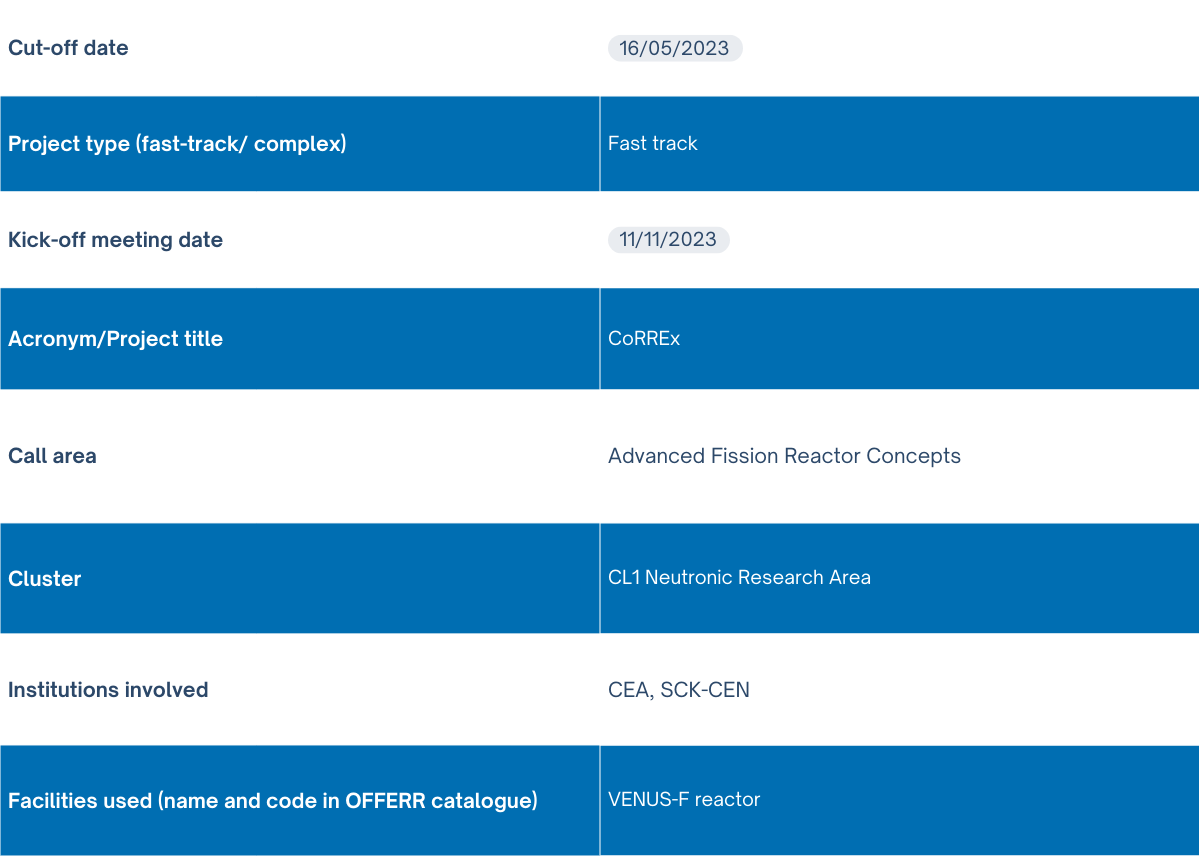
What is CORREX?
VENUS‑F is a fast, zero‑power reactor using solid lead and bismuth as coolant simulators, serving as a mock‑up of the MYRRHA reactor core. Extensive measurements of global and local neutronic parameters were performed, analyzed, and compared with Monte Carlo simulations. While the overall agreement between experiments and calculations is good, notable discrepancies remain for several quantities, particularly threshold spectral indices, where differences exceed the associated uncertainties.
To address these deviations, the CoRREx experiment (Complement to the Reaction Rate Experiments) is proposed to identify the neutron‑energy ranges where model limitations are most influential. The approach relies on neutron‑spectrum filtering during reaction‑rate measurements at selected core locations. By progressively attenuating well‑defined portions of the neutron spectrum using boron‑based filters (BN or B₄C), the experiment aims to quantify the impact of removing lower‑energy neutrons on the agreement between measured and calculated fission reaction‑rate ratios. Implementing such filtering techniques in fast‑spectrum conditions constitutes one of the main innovations of CoRREx.
Additionally, results obtained from fission chambers and data‑acquisition systems operated independently by SCK CEN and CEA will be cross‑compared to reinforce confidence in the measurements and further validate the experimental methodology.
Objectives
The CoRREx campaign is driven by two main objectives:
1- Identify which neutron‑energy ranges cause the discrepancies observed in spectral indices.
By selectively filtering parts of the neutron spectrum, CoRREx will determine how much each energy range—thermal, epithermal, and fast—contributes to the measured spectral indices. This will make it possible to:
- evaluate whether model inaccuracies in the epithermal region are responsible for the observed biases, or
- rule out the epithermal range and confirm that discrepancies originate mainly from the fast neutron spectrum.
In short, CoRREx aims to pinpoint where the modelling limitations lie within the neutron energy spectrum.
2- Demonstrate and validate measurement tools and neutron‑filtering techniques in a fast‑spectrum environment.
The campaign provides a rare opportunity to test fission chambers, data‑acquisition systems, and boron‑based spectral filters in a controlled fast‑reactor‑like configuration. This will help:
- assess the reliability and performance of the instrumentation,
- validate the practical use of neutron‑spectrum filtering in fast spectra,
- improve our ability to measure and model fast‑neutron fields.
Overall, CoRREx will both enhance our understanding of the root causes of current calculation‑to‑experiment discrepancies and expand our experimental capability to characterize and manipulate fast neutron spectra.
Main outcomes
Overall Service and Experimental Support
The infrastructure support provided by SCK CEN was very good. Access to the facility was smooth, and the experimental setup was fully prepared upon arrival. The VENUS‑F team efficiently handled the partial unloading and reloading of the reactor core to install the neutron filters. All measurements were backed by SCK reference detectors, simplifying data post‑processing. Their assistance in resolving a noise issue in the MONACO acquisition system—along with lending cables and detectors—was instrumental to the success of the campaign.
Key Achievements
- Comprehensive measurement campaign:
Spectral indices were successfully measured in four different configurations across multiple core locations, enabling a detailed investigation of the origins of the simulation–experiment discrepancies.
- Epithermal spectrum excluded as a source of the C/E bias:
The measurements demonstrated that the epithermal part of the neutron spectrum is not responsible for the observed discrepancies. This strongly suggests that the source of the C/E deviation lies in the fast neutron spectrum.
- Insight for nuclear data improvement:
The analysis indicates that revisiting or updating the ²⁴⁰Pu fission cross‑section evaluation could improve agreement between simulations and experiments.
- Scientific dissemination:
A research paper reporting the campaign and findings was written and submitted to Annals of Nuclear Energy.
Difficulties Encountered and Solutions Applied
- Delayed shipment of CEA fission chambers:
The temporary export license took longer than expected.
Solution: The experiment was slightly postponed to accommodate the delay.
- Suboptimal signal‑to‑noise ratio in the MONACO system:
This affected the quality of some spectral index measurements.
Solution: With support from facility colleagues, the noise issue was diagnosed and mitigated, and corrections were applied to the impacted measurements.
Publications
- Epithermal Neutron Spectrum Filtering Experiment Design at the VENUS-F Zero Power Fast Reactor, PHYSOR 2024 conference, 2024-04-24
- CoRREx: experimental investigation of model bias at VENUS-F through neutron spectrum filtering, Manuscript accepted for publication in Annals of Nuclear Energy
- The CoRREx campaign at the VENUS-F zero power reactor, Presentation at the JEFF week, 2024-11-26
- Activation of uranium foils for spectral index measurements in filtered neutron spectra at the VENUS-F reactor, 18th International Symposium on Reactor Dosimetry, 2025-05-19
Interest for use of reached results
2 research institutes and universities could be interested for first time boron filters applied to filtering epithermal neutron range in a fast system; a detailed description of the experimental methodology and data analysis.
4 research institutes could be interested in novel application of activation of uranium foils for spectral index measurement.