

COALA Project
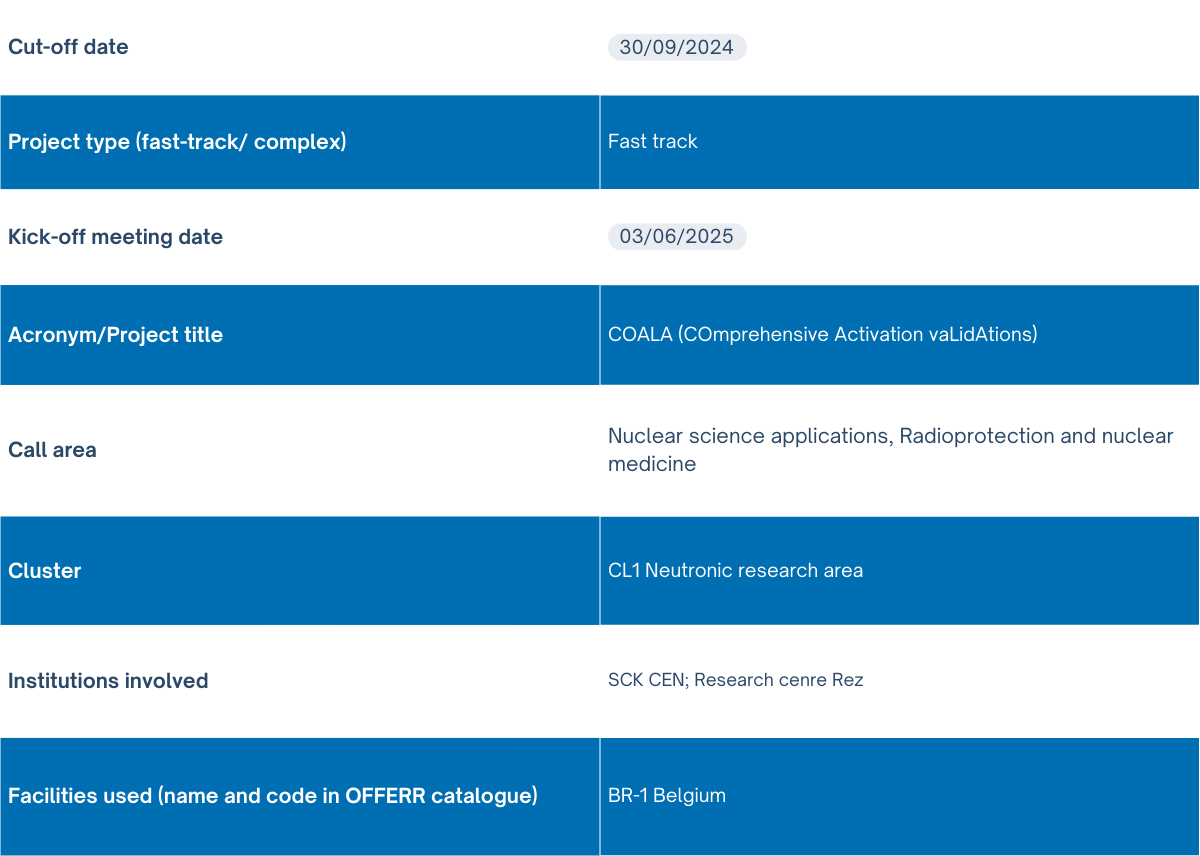
What is COALA?
The first part of the project will be performed in the fast field of the BR1 MARK-3 convertor focusing on the validation of the cross sections of selected reactions that are promising in reactor dosimetry: 204Pb(n,n´), 117Sn(n,n´), 64Zn(n,p), 67Zn(n,p), 92Mo(n,p), and 28Si(n,p).
The second part of the experiment will focus on validation of high energy tail of 235U PFNS (Prompt Fission Neutron Spectrum). This kind of measurements is actual, as the discussions concerning the shape of PFNS above 10 MeV is still ongoing. For this purpose we use well validated (n,2n) reactions, i.e.: 90Zr(n,2n), 63Cu(n,2n), 169Tm(n,2n), 169Tm(n,3n), 19F(n,2n), 141Pr(n,2n), 58Ni(n,2n), and 89Y(n,2n).
The last part is validation of capture cross sections. 141Pr(n,γ) is an important reaction because 141Pr is produced in burnt-up nuclear fuel in high quantities. 45Sc(n,γ), 181Ta(n,γ), 93Nb(n,γ), 115In(n,γ), and 113In(n,γ) are dosimetric reactions included in IRDFF-II, thus it is useful to validate them. 140Ce(n,γ) is significant reaction in astrophysics. This cross section is of great importance because it represents a bottleneck for the s-process nucleosynthesis and determines to a large extent the cerium abundance in stars. 176Yb(n,γ) is a possible way to produce medical isotope 177Lu via nuclear reactors.
Objectives
The project aims to carry out such experiments and calculations, which will allow validation of cross section of various important isotopes and determine spectral averaged cross sections for reactions important for fission, fusion reactor dosimetry, astrophysics or medical isotope production. The results of experiments will be published in the EXFOR database and peer-reviewed journal. Experimental results will be compared with the calculation using various nuclear data libraries. It will be determined, which of the available libraries show the greatest agreement between experiment and calculations. The experiment will be divided into four parts, the first part will be focused on threshold reactions for validation of 235U PFNS above 10 MeV.
Main outcomes
The results will be published in an peer-reviewed journal. The experimental data will be included in internationally acknowledged database EXFOR. Thus, published data will be available for potential users. The obtained results will show problems in the state-of-the-art nuclear libraries and can be used for validation and refining nuclear data evaluations.
Publications
Validation of 235U PFNS in MARK-3 converter. Applied Radiation and isotopes, expected publication in 8/2026
Interest for use of reached results
IAEA Nuclear data services, EXFOR IAEA