
CLASH Project
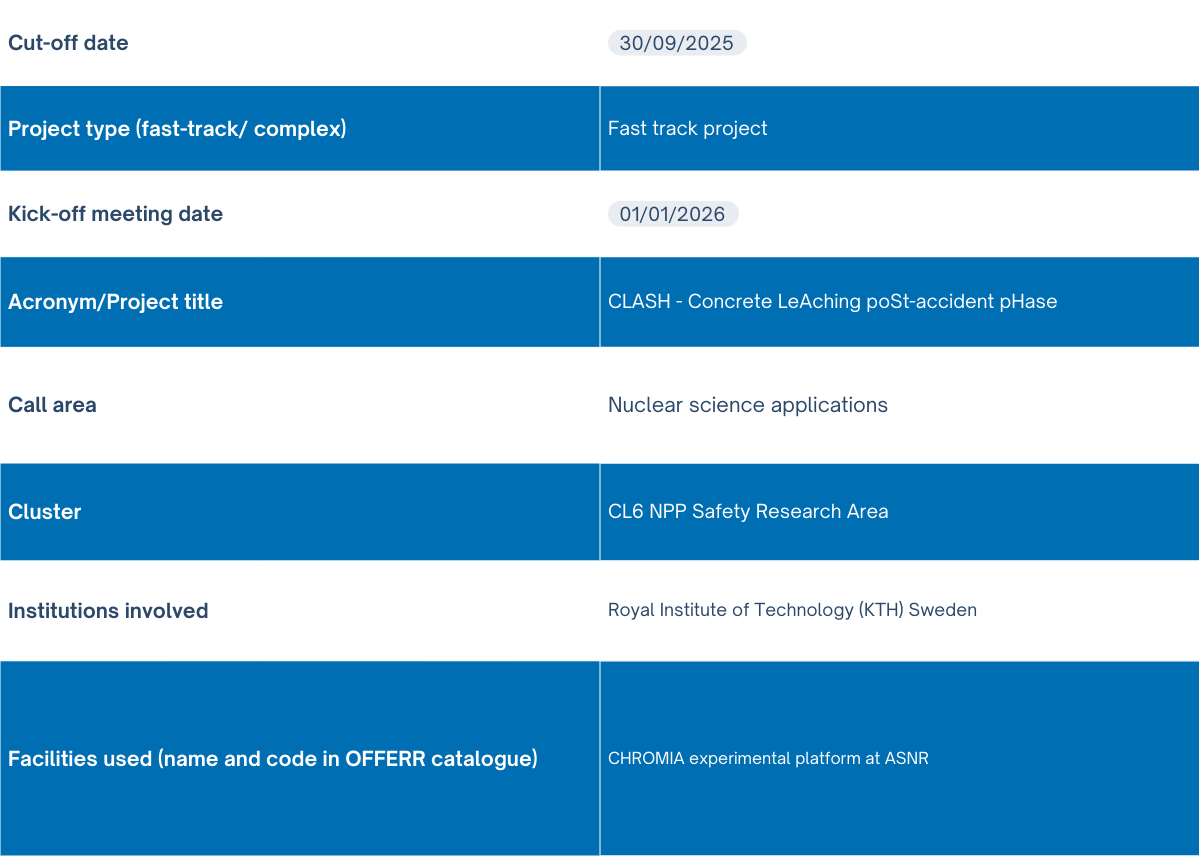
What is CLASH?
Leaching of degraded massive structures during the post-accident phase is not considered a main phenomenon to date, and no data is available in this context. Based on Fukushima-Daïchi observations a few years after the accident (absence of concrete wall in the reactoir pit of unit 1), this state has to be reviewed to get a clear understanding of how this phenomenon can affect structures. This phenomenon may be promoted by the thermal degradation of the concrete present in the reactor pit due to the presence of corium, which induces a high flux of heat on the concrete walls in the pit.
The objective of the CLASH OFFERR project is to conduct leaching tests on concrete samples (both thermally damaged and undamaged) over several weeks to assess the extent of leaching processes. This will enable extrapolations to a few years, evaluating whether such leaching processes could explain the complete dissolution of a relatively thick concrete wall. Depending on the outcomes, further investigations should be conducted to assess relevant parameters better.
Two samples of concrete (with a concrete mix representative of the concrete used in the French nuclear park) will be tested: a reference one without damage and another one after being thermally damaged, promoting water diffusion through the cracking network formed.
Relevant mechanical properties before and after leaching processes will be determined. Dissolved species will be also measured as a function of time.
Objectives
The objective of the CLASH OFFERR project is to conduct leaching tests on concrete samples (both thermally damaged and undamaged) over several weeks to assess the extent of leaching processes. This will enable extrapolations to a few years, evaluating whether such leaching processes could explain the complete dissolution of a relatively thick concrete wall. Depending on the outcomes, further investigations should be conducted to assess relevant parameters better.
Two samples of concrete (with a concrete mix representative of the concrete used in the French nuclear park) will be tested: a reference one without damage and another one after being thermally damaged, promoting water diffusion through the cracking network formed.
Relevant mechanical properties before and after leaching processes will be determined.
Dissolved species will be measured as a function of time.
Main outcomes
As deliverables of the proposal there will be:
A progress meeting will be organized between partners in the middle of the schedule.
A final report including:
- Characterizations of concrete samples (damaged and undamaged) before the leaching phase
- Leaching test results in terms of element releases,
- Characterizations of concrete samples after the leaching phase
- Analysis of the results and possible extrapolation of the concrete state after the long-term leaching phase.
In addition, from the Scientific and dissemination perspective: The main outcome of the study is to assess the extent of the concrete leaching phenomenon in the post-accident phase. Later on, it will be possible to extend the topic to know if concrete ageing may affect this phenomenon.
The results will be published in a common open publication in appropriate journal or at a conference.
Furthermore, taking into account the impact for end-users, These data will be communicated with a meaning of collaborative exchange of information with the OECD FACE project to understand specific MCCI phenomena leading to concrete damage without visible damage of the rebars, advance the interpretation of FD accident progression and identify remaining gaps in the post-FD analysis. The new knowledge and data will be used for development of new models of MCCI and identification of application boundaries of the models.
New insights into the concrete thermal and chemical degradation as well as the ageing process can also be expected in this study