
ChroTemp Project
What is ChroTemp?
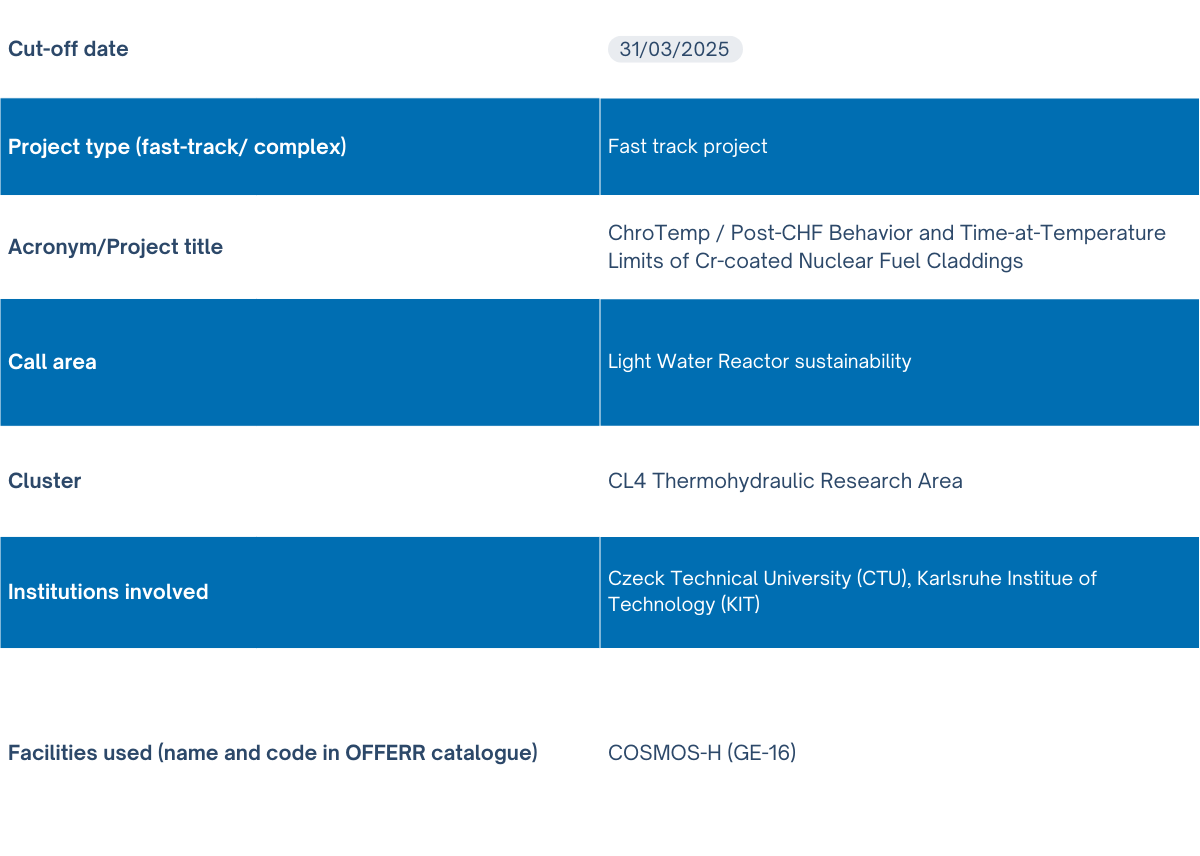
Departure from nucleate boiling is phenomena when nucleate boiling changes to film boiling and vapor layer occurs on the surface of fuel rod which leads to deterioration of heat transfer and heating up the cladding which can lead to cladding failure.
Accident Tolerant Fuel (ATF) claddings made of chromium-coated zircaloy have so far mainly been investigated in terms of neutronics and thermomechanics. The proposed project will now focus on the behaviour of Cromium-coated materials in the post-dryout phase.
In preliminary tests, an experimental procedure will be developed to analyse questions of thermohydraulics and subsequently also material behaviour. This includes the investigation of time-at-temperature limits. The needed experimental condition can be achieved in a COSMOS-H experiment by reducing the electrical heating power when the dry-out is reached.
First, samples of Cr-coated Zr-alloy cladding tubes and reference uncoated tubes will be produced. Once this procedure has been validated, the samples will be examined in a COSMOS-H experiment under typical LWR conditions from nominal operation to critical heat flux and in the post-dry phase.
The samples on which the critical heat flux is reached will be cut to examinate the mechanical and corrosion properties with emphasis on the difference in mechanical and corrosion behavior between the region where the CHF occurs and the region where no CHF was detected.
Objectives
The objectives of the ChroTemp project are the followings:
- To determine CHF and post-CHF characteristics of both Cr coated and uncoated Optimized ZIRLO and investigate degradation mechanisms to support the establishment of time at temperature criteria for LWRs.
- To directly study the effects of coatings on the performance of cladding materials by comparing the performance of coated and uncoated Optimized ZIRLO.
- To provide range of representative materials that experienced Dryout or DNB for post-test material investigations (long-term corrosion, H-pickup, mechanical properties, microstructure) that will be done outside of this project.
- To provide opportunity for collaborative research for three Phd students and one intern working on the topics linked to the establishment of TAT criterion.