
AT-ZIRC Project
What is AT-ZIRC?
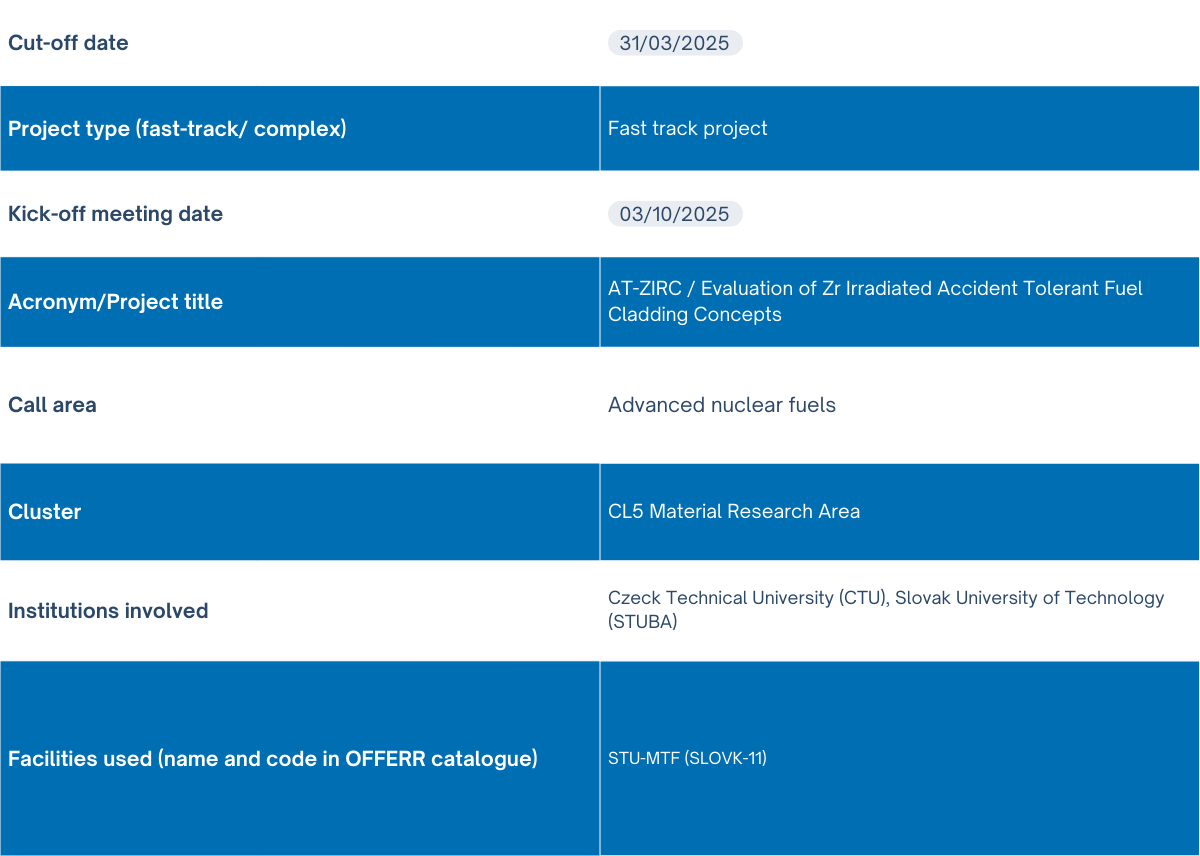
The project aims to evaluate the radiation resistance of advanced Accident Tolerant Fuel (ATF) cladding based on chromium-coated Optimized ZIRLO™ under simulated reactor conditions. While zirconium alloys are widely used in light water reactors for their excellent properties, they face limitations during accident scenarios due to their rapid oxidation in steam at high temperatures. Chromium coatings, applied via Physical Vapor Deposition (PVD), are a promising solution, offering enhanced oxidation resistance and mechanical durability.
This study focuses on the microstructural and mechanical stability of the chromium/zirconium interface when exposed to self-ion irradiation. Using 12 MeV Zr ions at 360 °C to achieve 6 dpa, we aim to simulate up to six years of in-reactor service. To ensure realistic geometry, a custom rotary sample holder will be used for uniform irradiation of tubular cladding samples. Pre- and post-irradiation characterization includes SEM, TEM, ToF-ERDA, and nanoindentation.
The outcomes will improve understanding of coating behavior under irradiation and provide essential data for the qualification of ATF cladding materials. This research supports the broader development of safer, more robust nuclear fuels and contributes to the objectives of the “”Advanced nuclear fuels”” call area.
Objectives
This research project investigates the radiation resistance of chromium-coated Optimized ZIRLO™ fuel cladding material under conditions that closely simulate nuclear reactor environments. The primary goal is to understand how these advanced cladding materials perform when exposed to radiation. Chromium-coated Optimized ZIRLO™ cladding samples will be irradiated using zirconium ions, targeting 6 dpa locally, which corresponds to approximately 5-6 years of in-reactor service life. Experiments will be conducted at 360 °C to replicate typical nuclear reactor operating conditions.
A custom rotary sample holder will be specifically designed and constructed to accommodate the tubular geometry of the cladding samples. This specialized holder will uniform radiation exposure during the experiments.
By examining the material’s response to simulated radiation damage, this research will provide critical insights into the long-term performance and durability of advanced nuclear fuel cladding materials.