

ASER3HE Project
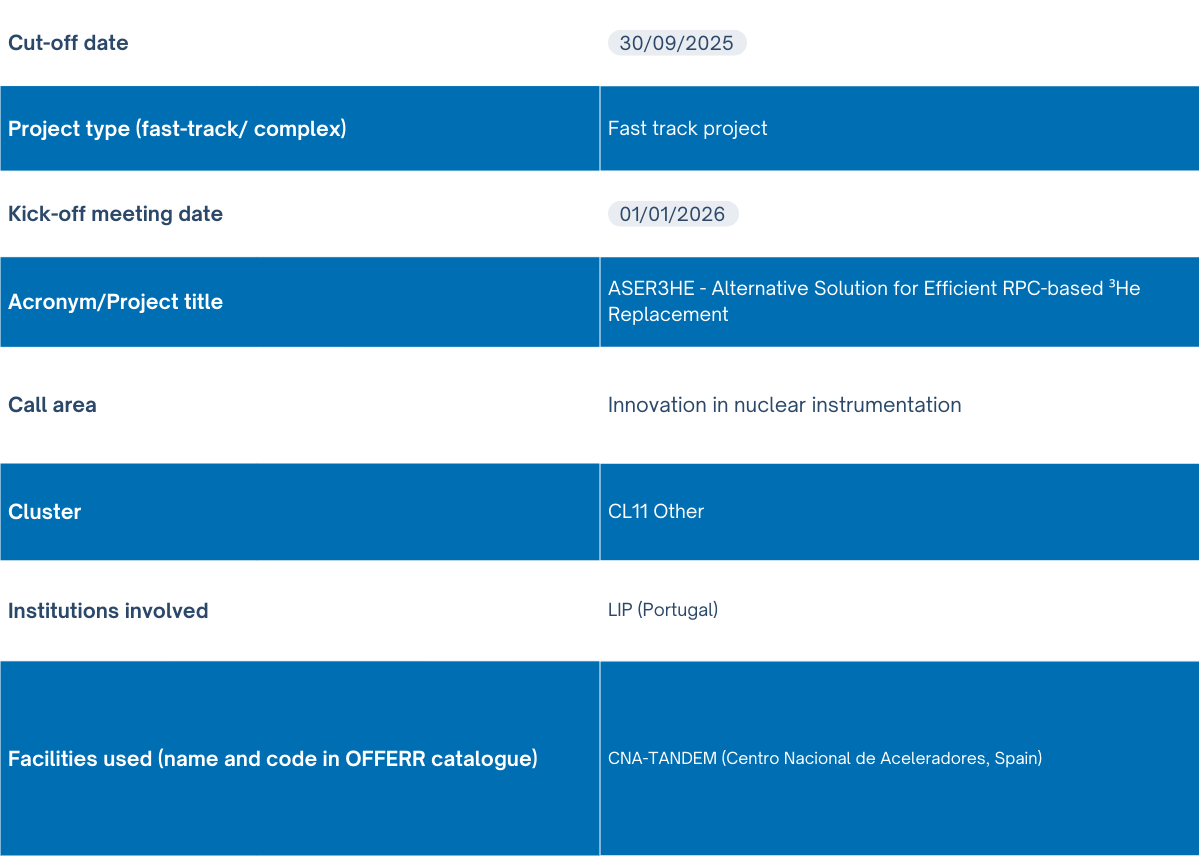
What is ASER3HE?
Fast neutron detectors are widely used in nuclear physics experiments including studies of elastic and inelastic neutron scattering, charge-exchange reactions, photonuclear reactions, neutron-induced fission, and reactions of radioactive nuclei. Some applications, however, do not rely on the measurement of the properties of the emitted particle, but rather on the counting of the number of emitted neutrons. This is the case for alpha particle induced reactions in low-background dark matter experiments, fission products from nuclear reactors or β-delayed neutron emitters. The latter has very relevant implications both in the working of power nuclear reactors, as well as in nuclear astrophysics nucleosynthesis processes. The state-of-the-art fast neutron detector concept for nuclear physics studies is based on moderated ³He-filled proportional neutron counters (³He tubes).
In this research project, it is proposed to explore the effectiveness of replacing ³He counters by ¹⁰B-RPCs via the development of detector geometries that replicate those from ³He counters. Both technologies (³He and ¹⁰B-RPC) will be tested under the same experimental conditions, characterizing detection efficiency, count rate capabilities, gamma-ray discrimination or background sensitivity. The detectors will be exposed to neutrons covering energies from a few keV to the MeV range.
Ultimately with this proposal, the aim is to develope a neutron detection concept that ensures the continuity in neutron detection capabilities across nuclear physics, reactor monitoring, homeland security, and medical applications, keeping the technology cost-effective while advancing detector technology through innovative materials and configurations.
Objectives
The project aims at achieving the following goals:
- Design and construct a prototype multilayer nRPC using 10B4C, coated on the electrodes, as converter material.
- Optimize the geometry to replicate the shape of standard 3He neutron counter tubes.
- Characterize the detector’s efficiency, gamma discrimination, and time resolution with radioactive sources.
- Benchmark the detector performance using epithermal and fast neutron beams, in direct comparison with equal size 3He counters.
- Assess scalability and integration potential for nuclear physics and reactor monitoring applications.
Main outcomes
In the context of this research proposal, the expect outcomes are:
- Fully functional prototypes of 10B-RPC neutron detectors replicating 3He counters.
- Performance characterization report comparing with 3He counters.
- Simulations benchmarking the developed geometry and detection efficiency optimization.
- Draft of a publication in a scientific journal
- Recommendations for scaling and industrial application.
In addition, the project will result in a novel neutron detection technology with the potential to replace 3He tubes in various applications. Scientific outcomes include performance benchmarks, validated simulation models, and insights into the implementation of this technology in existing neutron detection setups, considering both 3He replacement or scalability.
Dissemination will occur through peer-reviewed publications, presentations at international conferences (e.g., RPC2026), and seminars. The project will consider the involvement of a Master student in Physics or Engineering Physics, with the development of a Thesis project around the proposed experimental approach. Open-access data and design files will be shared to encourage replication and further development.