
ACCURATE Project
What is ACCURATE?
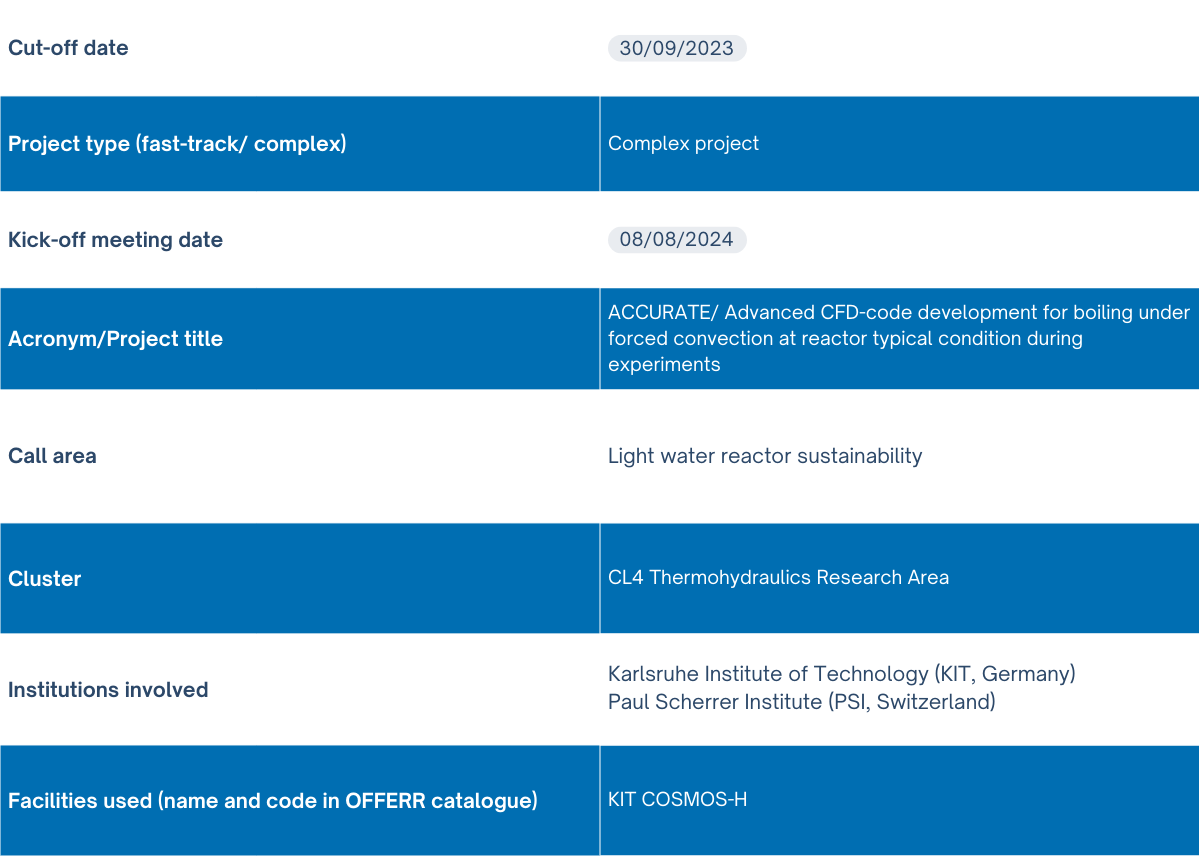
This project addresses a fundamental challenge in nuclear thermal hydraulics: predictive modeling of boiling flows under reactor-representative conditions. While Computational Fluid Dynamics (CFD) has advanced significantly, its reliability for simulating subcooled convective boiling and critical heat flux (CHF) remains limited by a lack of high-fidelity experimental data at prototypical pressures and temperatures. This project will leverage the COSMOS-H facility at Karlsruhe Institute of Technology, uniquely equipped with newly developed high-pressure sight glasses and advanced fiber-optic temperature measurement systems, to provide unprecedented insights into bubble nucleation, growth, and departure processes. CFD simulations using both interface-tracking and Eulerian approaches will yield comprehensive datasets, measured at COSMOS-H facility, for code validation and model development. The open-source CFD code PSI-Boil will be extended and validated against these experimental results, enabling mechanistic simulation of boiling flows from nucleation to boiling crisis. Outcomes will include improved predictive models for boiling heat transfer, validated simulation tools applicable to full fuel assemblies, and high-quality experimental datasets for broader use in the reactor safety community. Ultimately, the project contributes to light water reactor sustainability, enhances confidence in safety margins, and supports the development of advanced nuclear reactor concepts including small modular reactors.
Objectives
The primary objective of ACCURATE is to establish a validated experimental and computational framework for the study of boiling flows under reactor-typical conditions (70–155 bar, up to 355°C). This requires a dual strategy: enhancing experimental capabilities at the COSMOS-H facility and advancing CFD models for mechanistic prediction of CHF phenomena. On the experimental side, the project will implement two major upgrades: (i) installation of a high-pressure sight glass module with a 45 mm optical window to capture bubble dynamics with high-speed imaging, and (ii) deployment of fiber-optic temperature measurement technology to replace conventional thermocouples, providing high-resolution surface and fluid temperature data. These enhancements will allow unprecedented observation of bubble nucleation, growth, lift-off, and coalescence under prototypical reactor conditions. On the computational side, the project will extend the PSI-Boil code through two complementary approaches: interface-tracking simulations to directly resolve liquid-vapor interfaces and elucidate CHF mechanisms, and Eulerian-based simulations to optimize empirical models for large-scale reactor applications. Experimental data will not only support model calibration but will also be made openly available for the broader nuclear research community. Together, these objectives will lead to a validated CFD tool capable of predictive simulations of boiling flows up to crisis conditions, strengthening reactor safety analyses and supporting the design and operation of future light water and modular reactors.
Main outcomes
The ACCURATE project is expected to deliver transformative outcomes for nuclear safety research and CFD development. First, a high-quality experimental database of boiling flows under reactor-representative conditions will be established. This dataset will capture detailed bubble dynamics and local heat transfer characteristics, including onset of nucleate boiling, bubble departure frequency, and nucleation site density, measured with both optical and fiber-optic diagnostics. Second, the PSI-Boil CFD code will be significantly enhanced. The interface-tracking method will be validated against experimental data, providing mechanistic insight into CHF mechanisms that cannot be directly observed experimentally. Meanwhile, empirical correlations embedded in Eulerian models will be systematically tuned, enabling large-scale simulations of entire fuel assemblies without requiring supercomputing resources. Third, the project will generate openly accessible data and validated CFD models, empowering both academic and industrial users to improve reactor safety analyses, design studies, and licensing support. By enabling more accurate predictions of boiling crises, these outcomes directly support safe operation of current nuclear power plants and the development of next-generation small modular reactors. Furthermore, the demonstration of optical access to high-pressure boiling flows represents a major technological breakthrough, paving the way for future experimental programs. Collectively, the outcomes position ACCURATE as a critical step toward predictive, validated CFD for boiling heat transfer at reactor conditions.
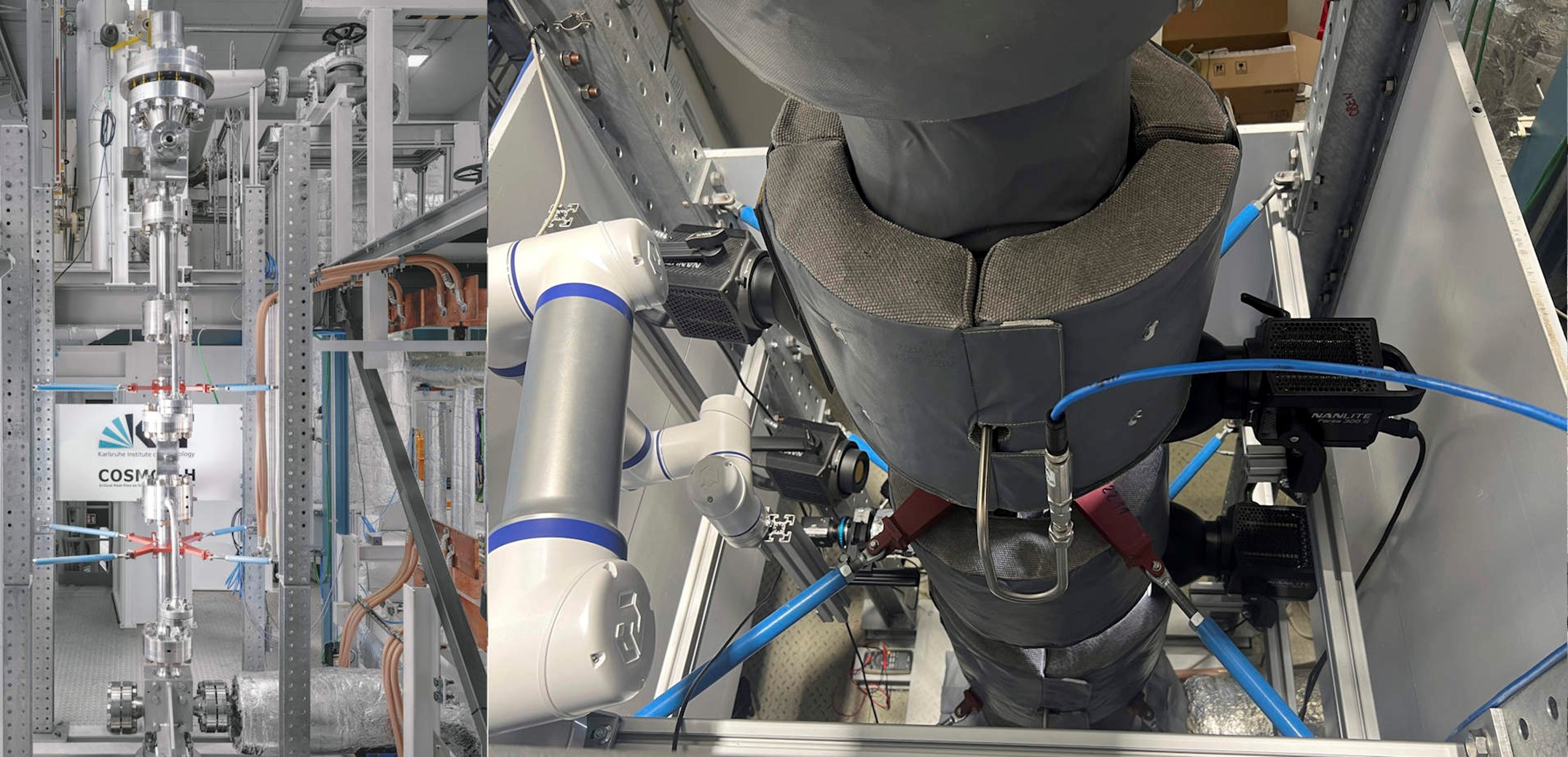
Photos of the experimental setup: (left) side view of the test section without thermal insulation, showing the main structure and instrumentation ports; (right) close-up view of the insulated test section equipped with cameras, thermocouples, and pressure probes for detailed measurements.
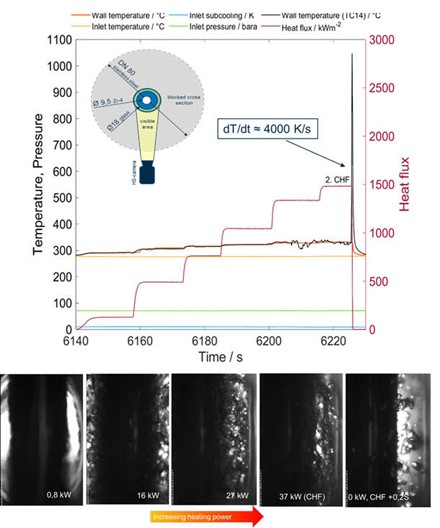
Boiling flow experiment conducted at approximately 80 bar, showing the progression from low heat flux to critical heat flux (CHF). (Top) Time evolution of wall temperature, inlet subcooling, inlet temperature, inlet pressure, and applied heat flux. (Bottom) High-speed camera images showing bubble dynamics at different heating powers.
Publications
- Feb. 2026, Eulerian CFD simulation of subcooled convective boiling flow based on the observation of nucleation site density
- Jul. 2026, Interface tracking simulation of boiling flow at 80 and 150 bars
Interest for use of reached results
Framatome
Westinghouse Electric Sweden
GE Hitachi Nuclear Energy