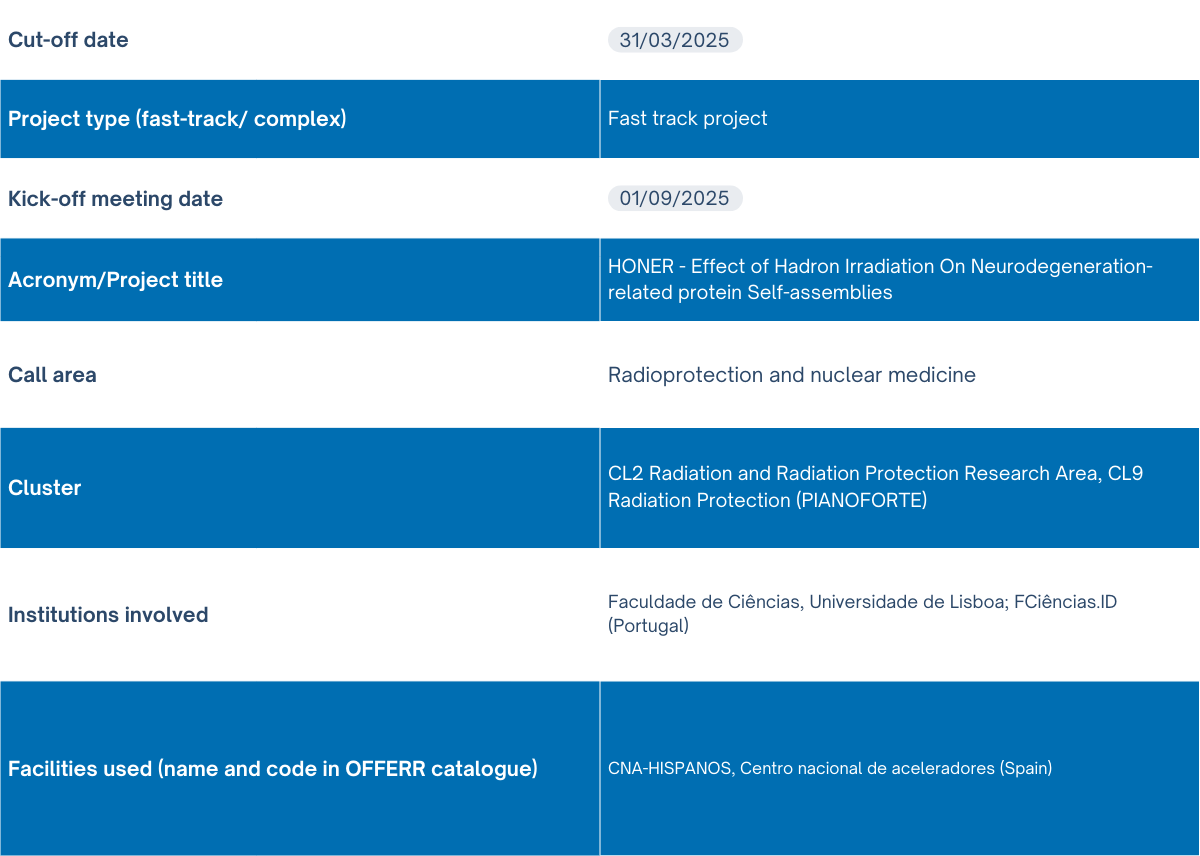
HONER Project
What is HONER?
Current evidence indicates that conventional radiotherapy could be beneficial for treating neurodegenerative disorders where amyloid deposits are involved, but radiotoxicity in an already weakened, post-mitotic tissue could be deleterious. New radiotherapy approaches based on high energy particles such as protons and neutrons (i.e. hadrons) can deposit higher energy in deeper tissues, such as the central nervous system, without damaging surrounding healthy tissue.
HONER will perform for the first time a direct comparison of both neutrons and protons on the same type of amyloids and other supramolecular assemblies in a living cellular context, paving the path towards an effective use of radiotherapy against neurological disorders.
We will first develop new cell models of Huntington´s disease and Spastic Ataxia 8 on post-mitotic neuronal cells and the extremophile bacteria D. radiodurans, which will allow testing hadron irradiation in live-cell contexts on an unprecedented scale of several orders of magnitude (0.5 Gy-10 kGy). Second, we will compare the effect of electrons, photons and hadrons on amyloids in the presence and absence of boron-containing probes that can be specifically targeted to amyloids.
HONER will lay the groundwork for the possible application of hadrontherapy to treat amyloidosis and neurodegenerative disorders. HONER has the potential to greatly increase the versatility and usage of new clinical particle accelerators that are currently being built worldwide. Furthermore, the effects of hadrons and other types of irradiation on protein aggregates could have biotechnological applications, such as disaggregation or controlled fragmentation of therapeutic antibodies or peptidic hormones, such as insulin.
Objectives
The overall goal of HONER is to determine the effects of hadrons on amyloids and other supramolecular assemblies in a cellular context. To fulfil this goal 3 specific objectives will be addressed:
- DEVELOP NEW RADIATION-RESISTANT CELL MODELS OF NEURODEGENERATIVE DISORDERS (TASK 1, 3 months) to compare the effect of electron, photon and hadron irradiation on the self-assemblies of amyloidogenic and physiological proteins in living cells.
- ANALYZE THE EFFECT OF ELECTRONS/PHOTONS ON AMYLOIDS IN LIVING CELLS (TASK 2, 3 months). Local facilities will be used to set a workflow for irradiation in our cellular models, and establish a dosage range to compare the effects of conventional radiotherapy with hadrontherapy in this context.
- ANALYZE THE EFFECT OF HADRONS ON AMYLOIDS IN LIVING CELLS (TASK 3, 4 months). Protons and neutrons can be captured by boron isotopes, emitting alpha particles with high Linear Energy Transfer (LET) in very short distances (a few microns). A series of boron compounds have been identified in the literature that can be specifically targeted to amyloids. The objectivee is to determine if they have potential for therapeutic hadron capture in the context of amyloidosis.
Main outcomes
Expected potential outcomes: HONER will lay the groundwork for the possible application of hadrontherapy to treat amyloidosis and neurodegenerative disorders. HONER has the potential to greatly increase the versatility and usage of new clinical particle accelerators that are currently being built worldwide.
Furthermore, the effects of hadrons on protein aggregates could have biotechnological applications, such as controlled fragmentation of therapeutic antibodies or peptidic hormones (e.g. insulin). HONER dissemination strategy will target the scientific community by 1) publishing in open access, high-impact journals (at least 1 publication on a top journal is envisaged); 2) participating in national (2 communications: SPN and SPB meetings) and international meetings (2 communications: SFN, ISN, FENS, FEBS and SBBq meetings); 3) joining international consortia and other networking programmes; and 4) making available the cell lines, molecular tools and constructs, proteomics datasets and computational tools developed during HONER, through public cell banks, plasmid repositories, open databases, professional accounts (ResearchGate, Academia.edu,…). These Open Science initiatives will greatly increase our visibility and help involved teams to consolidate a reference position in the field of radiobiology