

CALORRE Project
What is CALORRE?
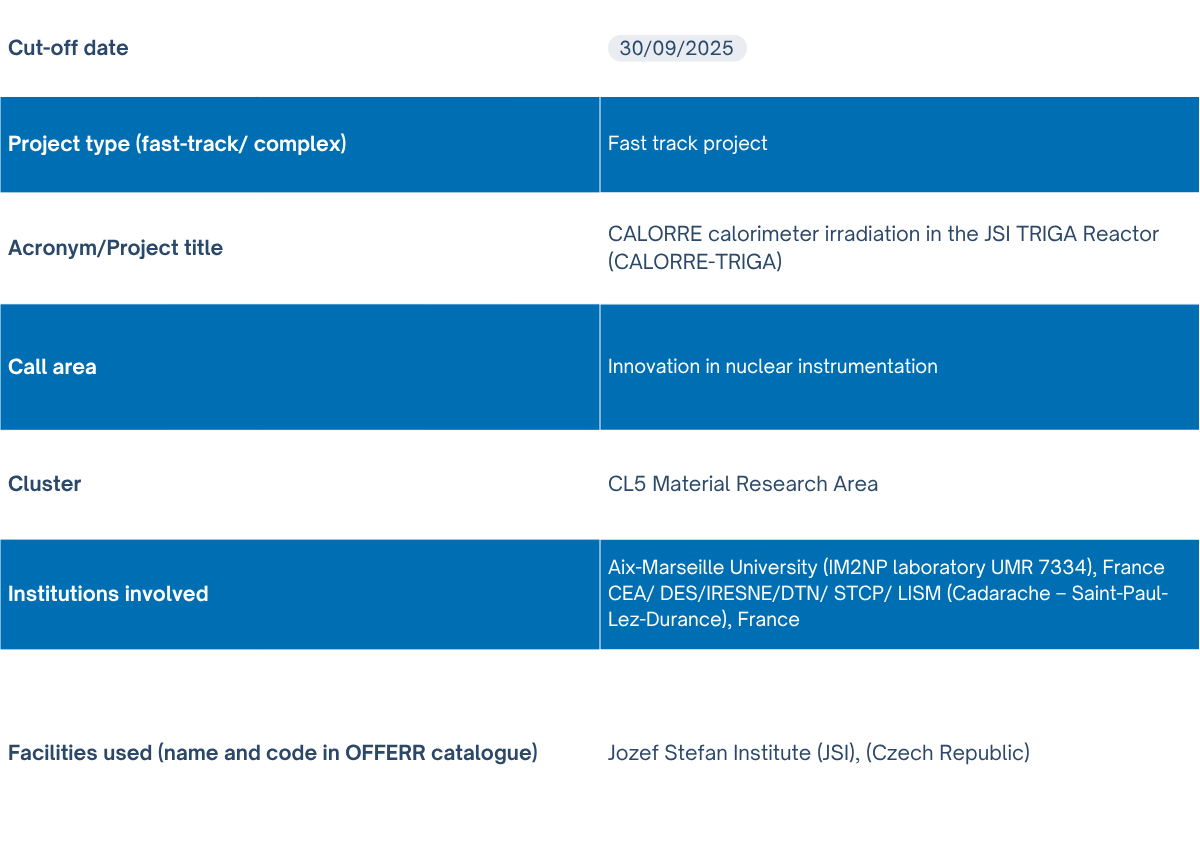
The project focuses on specific sensors (heat-flow calorimeters) to realize accurate on-line measurement of a key quantity (the nuclear heating rate) in research reactor. The project is composed of two objectives:
- an advanced qualification of a new compact dual-sample differential calorimeter prototype (CALORRE-type, with Stainless Steel and Tungsten samples) associated to an ionization chamber and a mechanical displacement system, thanks to a 4-day irradiation campaign in the central channel of the JSI TRIGA reactor
- and the fabrication of a first CALORRE calorimetric cell structure by 3D-printing and its characterization without and with nuclear conditions.
The project is based on a comprehensive methodology that has been developed for other calorimeter prototypes.
The CALORRE-TRIGA project proposal represents a unique opportunity to:
(i) characterize a new CALORRE calorimeter prototype and realize simultaneously axial profiles of temperature, nuclear heating rate and gamma flux in the JSI reactor for the first time, (ii) obtain a new and independent set of experimental data on the nuclear heating rate in different materials in the core of the JSI reactor, (iii) support verification and validation of JSI computational model, in particular the generation, transport and energy deposition from prompt and delayed gamma radiation, and (iv) mature and qualify the Metal additive manufacturing by Fused Filament Fabrication (Metal-FFF) route by manufacturing a first CALORRE 3D-printed calorimetric-cell structure and testing it under irradiation conditions.
Objectives
- The study of the CALORRE dual-sample calorimeter prototype in JSI reactor core.
This prototype has two superimposed calorimetric-cells and two specificities: it is the most compact differential-calorimeter, to date; and each calorimetric cell contains a material sample for simultaneous characterizations (stainless steel-316L, tungsten). This prototype has already been designed, manufactured and pre-tested in JSI reactor in 2025 using a classical calibration-based method without mechanical displacement-system and ionization chamber. By applying new measurement methods and adding an ionization chamber and a mechanical displacement-system, the study versus different reactor powers and axial positions will allow:
- the calorimeter-behavior characterization
- for the first time in JSI reactor, simultaneous determinations of accurate axial-profiles (temperatures, nuclear heating in two materials and gamma flux) and the delayed-gamma-heating rate quantification
These new experimental results will be compared with numerical results obtained with JSI reactor code.
- The study of the fabrication of one calorimetric-cell structure by 3D-printing (metal additive fabrication using the FFF process) for the first time and the test of this cell during the same campaign to characterize its behavior under irradiation conditions by analyzing its response in temperatures versus time at different steps of this campaign.
Contact: Prof. Christelle Reynard-Carette (christelle.carette@univ-amu.fr)