

CreepAlloy Project
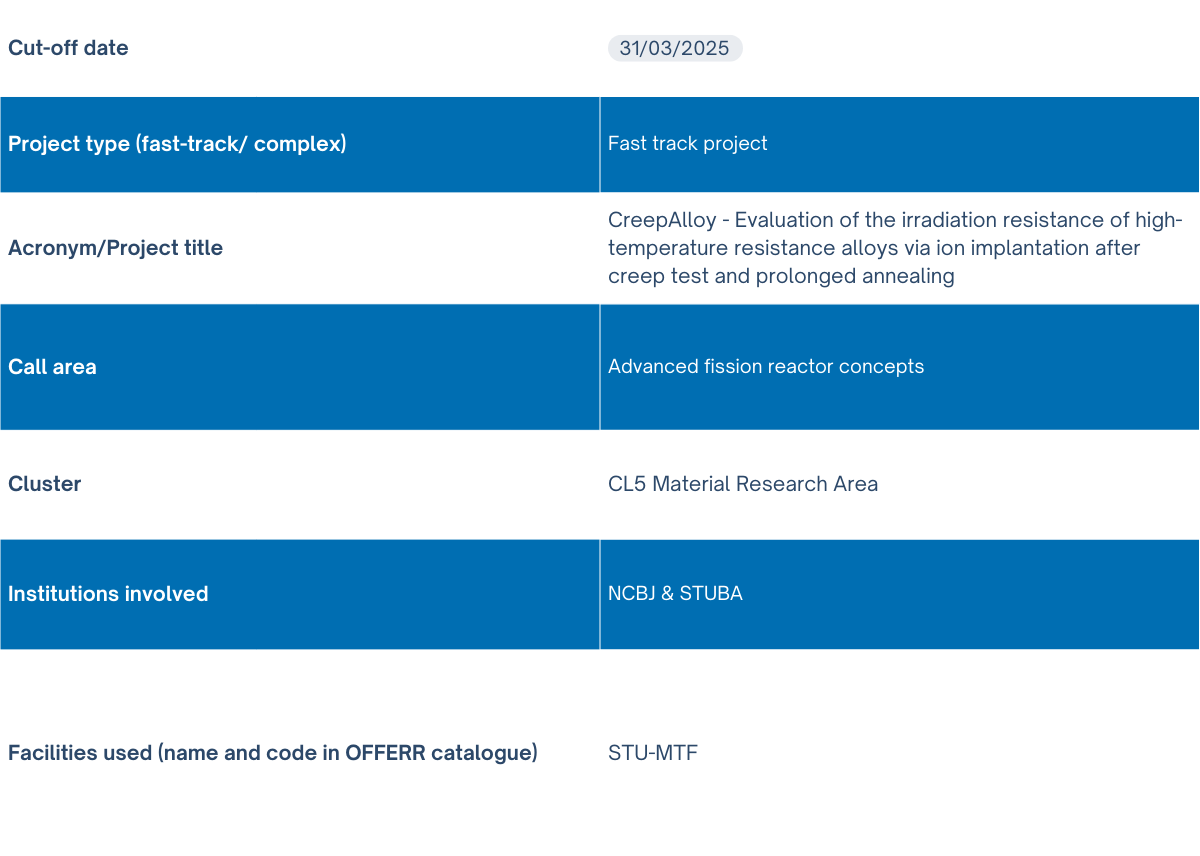
What is CreepAlloy?
The requirements for materials for the construction of Generation IV nuclear reactors are very high in terms of high-temperature strength and irradiation resistance. Nevertheless, there are many candidate materials for these applications. However, the irradiation resistance is mainly studied by ion implantation of the materials after fabrication. Other factors, such as mechanical loads or high-temperature exposure that affect microstructure during operation in a nuclear reactor are often disregarded as factors modifying irradiation response.
This project aims to fill the gap in understanding the irradiation resistance of materials submitted to operation conditions. Three different alloys will be studied, i.e., Inconel 617, 316L stainless steel, and Fe12Cr5Al oxide dispersion strengthened (ODS) alloys. Self-ion irradiation (Ni or Fe) will be conducted on alloys in as-fabricated conditions or after a creep test, either after prolonged high-temperature annealing. Moreover, the irradiation response of Inconel 617 produced by traditional metallurgy methods will be compared with the irradiation behavior of Inconel 617 prepared by additive manufacturing using directed energy deposition techniques. The ion implantation, which will mimic the neutron irradiation occurring in a nuclear reactor, will be performed with an energy of 5 MeV and a fluence of 5·1015 ion/cm2. Two selected samples will be irradiated with a higher fluence to understand irradiation resistance further. It should be noted that the implantation will be performed at 650 °C, which is close to the actual operating conditions. The ion-implanted layers in studied materials will be later investigated at NCBJ using nanoindentation, GIXRD, and TEM.
Objectives
The main objective of the work is to evaluate the irradiation resistance of high-temperature resistance materials after creep tests (Inconel 617, 316L stainless steel) and annealing at 475 °C for 1000 hours (FeCrAl ODS). The irradiation behavior will be assessed by Ni+ or Fe2+ ion irradiation (depending on the sample) at 650°C with a fluence of 5·1015 ion/cm2. It is expected that the microstructure after the creep test (mainly dislocation structure) and prolonged annealing will impact the irradiation resistance of the studied alloys. Moreover, the obtained results will help to answer whether the preparation conditions can significantly impact irradiation resistance. The objective of the project could be divided into partial objectives, which are summarized below.
- Evaluation of irradiation resistance of Inconel 617 and 316L stainless steel after creep test.
- Comparison of the impact of preparation technique (additive manufacturing vs. traditional metallurgical process) on irradiation resistance of Inconel 617 alloy.
- Determination of the effect of 475 °C for 1000 hours on irradiation resistance of FeCrAl ODS alloys.