

CHALEUR 2 Project
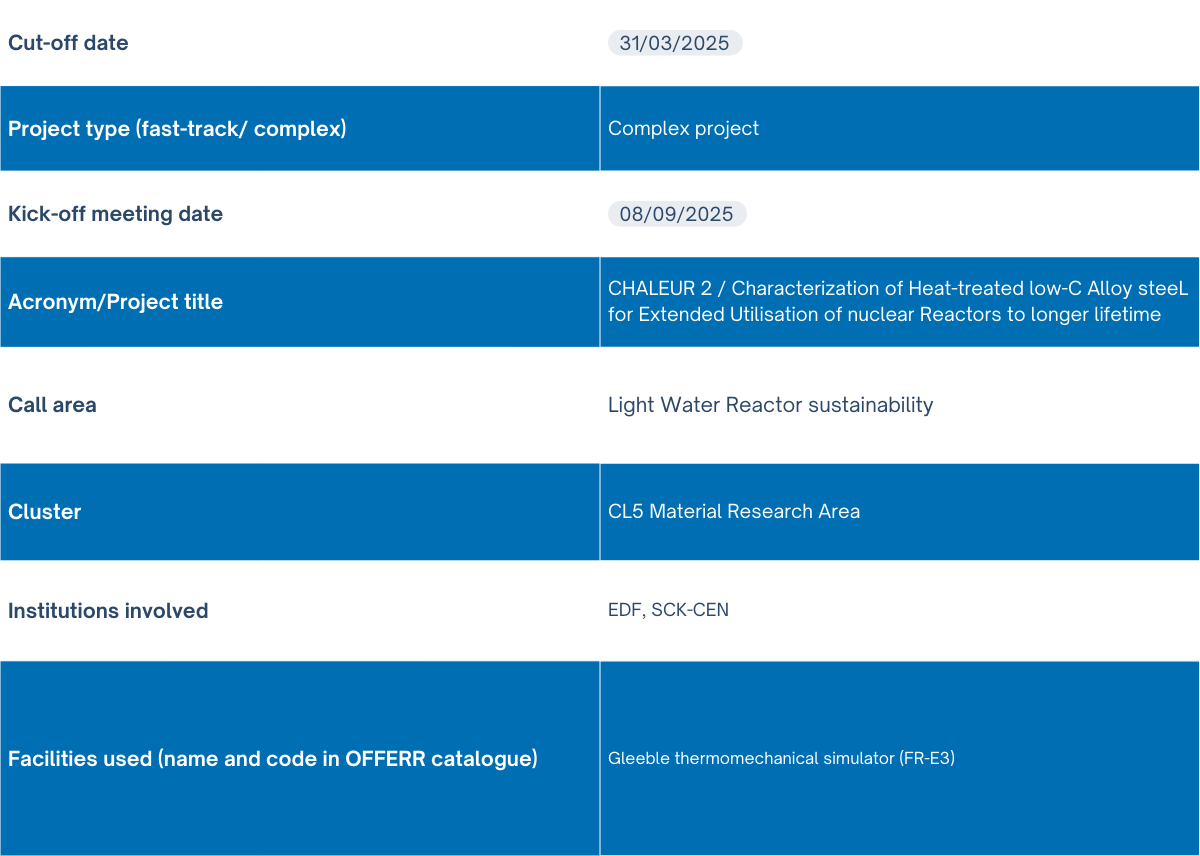
What is CHALEUR 2?
The CHALEUR2 project builds on the extensive heat‑treatment knowledge and mechanical testing database developed in the initial CHALEUR program. Its central objective is to evaluate fracture toughness using miniaturized Compact Tension (mCT) samples and to link these results to microstructural characteristics. This study is the first to systematically examine microstructural effects using homogeneous material batches with identical chemical composition, enabling a more controlled evaluation of how heat treatment influences fracture behavior.
Two notable observations guide the investigation. First, only one heat‑treatment (HT) condition shows a reduction in Charpy Upper Shelf Energy, despite both HT batches exhibiting decreased high strain‑rate tensile properties. This discrepancy raises questions about the microstructural mechanisms governing toughness at different strain rates. Second, only a single mCT test batch from the reference condition has so far been compared with Charpy impact results. This comparison revealed an unexpected relationship between the ductile‑to‑brittle transition temperature at 41 J (T41J) and the reference temperature (T0) obtained from the Master Curve methodology.
The project also examines how local microfracture stress in mCT samples reflects the combined influence of tensile flow strength (which governs ductile deformation) and microcleavage fracture stress from Charpy tests (associated with crack initiation at high strain rates). Variations in either component can raise the overall fracture resistance. By comparing cleavage stresses derived from load–displacement curves with those obtained through microstructural analysis and detailed fractography, the study aims to clarify how strain rate and temperature jointly control fracture initiation and propagation.
Objectives
The first objective is to obtain several similar (chemical Carbon content) batches of “microstructurally homogeneous” low alloyed steel specimen in terms of (i) location in a large forged heavy component, (ii) thermal treatment history. To reduce the discrepancy inherent to manufacturing processes, these steps have to be artificially done in a homogeneous manner. The infrastructure used ensures the fine-tuning and repeatability of the heat treatments provided, especially for quenching cooling rate which is considered as a critical parameter.
The second objective is to characterize these heat-treated batches using innovative testing methods beyond the standard tests, such as fracture toughness by mCT’s and NT (notched tensile) tests. Analysis will give information and will explain the strain rate effects, triaxiality, and critical damage (void, coalescence).
Eventually, the final objective is to characterize in-depth the microstructure and fractography to identify the cleavage initiation site, carbide/inclusion population(s), the former austenite grain size, ferrite packet size and other important features.
Those results are very important to explain the observed differences in macroscopic properties and can be used by the scientific community to develop micromechanical models (outside of the scope of CHALEUR2), such as the local approach.