
CSPEL Project
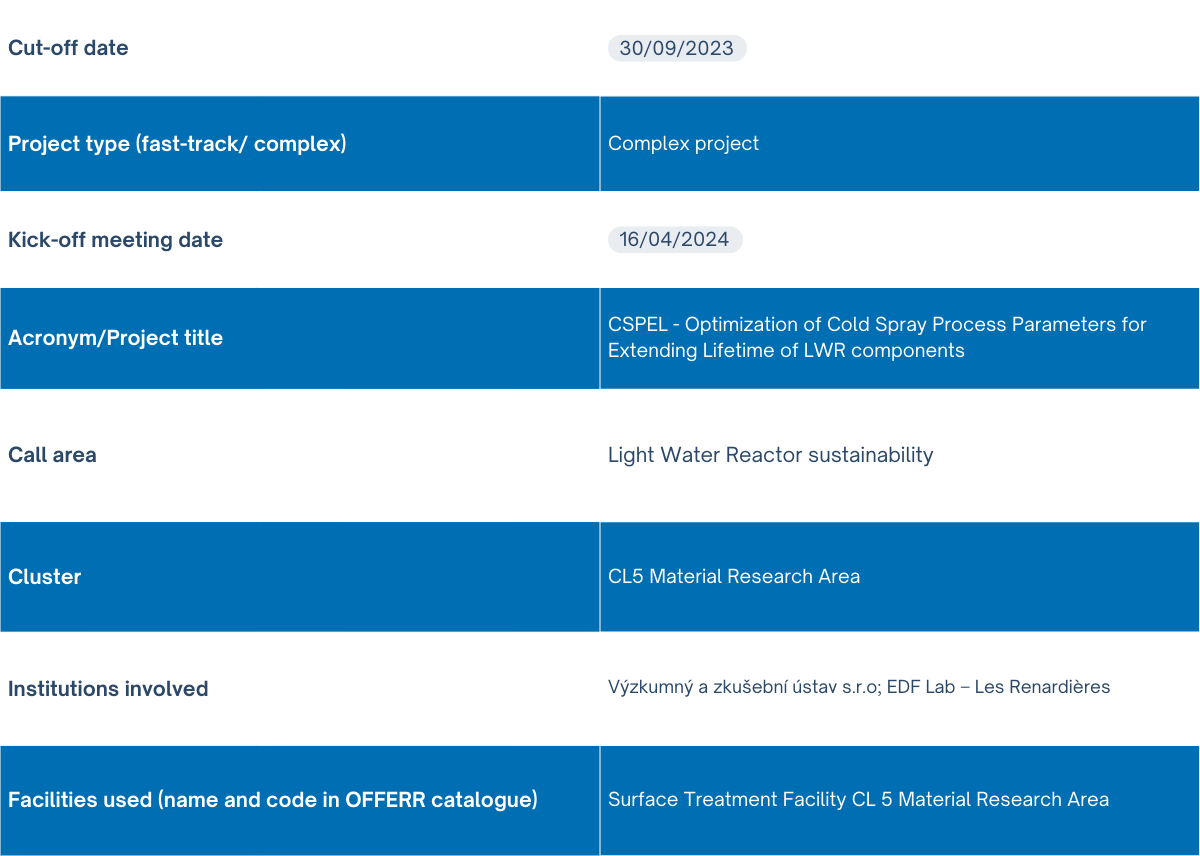
What is CSPEL?
The project explores cold spray technology as a promising approach for repairing defects in light water reactor (LWR) components. The research focused on systematically optimizing process parameters for coatings made of 316L austenitic stainless steel and IN625 nickel-based superalloy. The study evaluated how gas pressure, gas temperature, incidence angle, scan speed, and scan strategy affect important coating qualities, including microstructure, adhesion, porosity, and micro-hardness. Through parameter optimization, high-quality and thick coatings were produced, exhibiting good adhesion, low porosity, ductile behavior, and controlled hardness for both alloys.
These coatings were applied to pre-cracked samples simulating real-world defects. Results demonstrated partial success in repairing cracks, with the IN625 alloy showing better crack closure than 316L. This improved performance is attributed to the higher ductility of IN625 powder particles, allowing greater deformation and stronger bonding upon deposition, while the relatively lower ductility of 316L limited its effectiveness in closing cracks. The findings highlight that modifying scanning strategies, such as changing the incidence angle or scan pattern, could potentially enhance repair outcomes, although this was not tested during the project. In summary, the study confirms that cold spray can be an effective repair method for LWR components, and further advances in process design may lead to even more reliable results.
Objectives
The goal of the project is to test and verify the functionality of application of cold sprayed coatings for repair of defects of nuclear power components to prolong their lifetime.
The first step is to proceed with systematic optimization of the Cold spray parameters for the key coating materials used for LWR components – stainless steel alloy 316L and nickel-based superalloy Inconel 625. The main focus is to assess the influence of the Incidence angle, Scan speed and Scan strategy on the resulting coating quality – microstructure, adhesion, porosity and micro-hardness.
Second step is the development of repair procedure based on the results from parameters optimization. The coatings will be applied to pre-cracked samples representing real defects on nuclear power components. The quality of applied coating on such defect will be analyzed to verify the potential use of this method.
Main outcomes
In conclusion, it was demonstrated during this study that it is possible to produce Cold Spray coatings of 316L austenitic stainless steel and IN625 nickel-based superalloy with optimized metallurgical and mechanical quality (good adhesion and low porosity, ductile behavior and controlled hardness), which can reach high thicknesses (~ 10 mm).
However, the tests to repair the cracked sheets have been partially successful. In some cases, the cracks could not be closed, especially during the 316L stainless steel tests. The probable reason could be the higher ductility of IN625 powder particles, enabling better deformation upon impact and promoting stronger bonding between splats. On the other hand, SS316L, being relatively less ductile, has limited deformation capability, which might hinder effective bonding between splats.
It was observed that changes in projection strategies (angle, pattern) would remedy these failures and could eventually close all the cracks that have been created. This solution was not tested during the project but offers a good opportunity to go further.
In perspective, it could be interesting to continue this work on mock-ups with representative geometries of typical structures to be repaired, such as flat, wedge, corner or tube welded junctions. Furthermore, it would be advantageous to be able to characterize more precisely the metallurgy of coatings and the effect of heat treatments in order to be able to confront the results to the current requirements of repairs of metallic components. Finally, other perspectives, such as non-destructive testing of repairs, their performance in service (thermal aging, aging under irradiation, corrosion resistance, static and dynamic mechanical properties etc.) or the deployment of the Cold Spray technology on site could be challenged in future studies.
Results
Publications
Avneesh Kumar, Marek Vostrak, Sarka Houdkova, Thibaut De Terris; May 5–8, 2025. “Machine Learning Optimization of IN625 Coating Properties in Cold Spray Process.” Proceedings of the ITSC 2025. Thermal Spray 2025: Proceedings from the International Thermal Spray Conference. Vancouver, Canada. (pp. pp. 206-213). ASM. https://doi.org/10.31399/asm.cp.itsc2025p0206
Interest for use of reached results
FRAMATOME, WESTINGHOUSE, ČEZ, a. s., Doosan Škoda Power a.s, Slovenské elektrárne, a.s., SÚJB (Czech State Office for Nuclear Safety)